
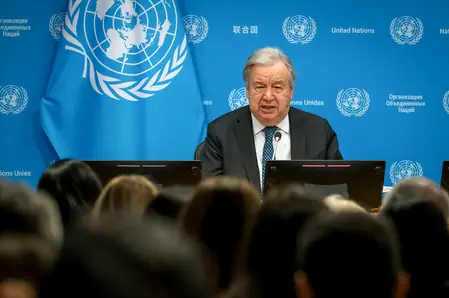
ADDIS ABABA – United Nations Secretary-General Antonio Guterres has reaffirmed his commitment to deepening collaboration with the African Union amid the continent’s bold strides against mounting global challenges.
Speaking to journalists at the 39th African Union Summit held at the AU headquarters in Ethiopia’s capital, Guterres praised Africa’s resilient approach to tackling development hurdles. ‘Africa is confronting the world’s toughest challenges with courage, fresh ideas, and resolve,’ he stated, highlighting ongoing efforts in regional unity, clean energy investments, and infrastructure upgrades.
While acknowledging that progress varies across regions and can sometimes feel sluggish, Guterres emphasized that real change is underway. He painted a stark picture of the current international landscape, describing it as more fractured, unpredictable, and unstable than post-Cold War eras.
The UN leader outlined three key priorities for enhanced UN-AU partnership: peace and security, financial justice, and combating climate change. Africa’s many fast-growing economies, he noted, are nonetheless crippled by debt burdens, high interest rates, and a lack of long-term financing, which hampers investments in education, health, and job creation.
Guterres decried the unfair global financial system that continues to marginalize developing nations, urging greater voice for them in international institutions. On climate, he slammed the injustice of Africa suffering disproportionate impacts—droughts, floods, famine, and extreme heat—despite minimal contributions to emissions.
‘With proper support, Africa could become a global powerhouse in renewable energy,’ Guterres asserted, calling for urgent international backing to transition to clean power and build resilience. He spotlighted crises in Sudan, DR Congo, the Sahel, and the Horn of Africa, stressing that African institutions need more than political rhetoric—they require resources and global solidarity to curb violence.
As the summit unfolds, Guterres’ words signal a pivotal moment for multilateralism, positioning UN-AU ties as a beacon for equitable global progress.