
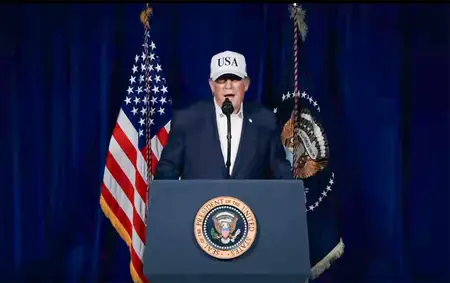
Washington is ablaze with controversy following President Donald Trump’s abrupt decision to launch military strikes on Iran. The move has ignited a fierce partisan divide, with Democratic leaders slamming it as reckless and unconstitutional, while Republicans hail it as a bold defense of American interests.
Senior Democrats wasted no time in their criticism. Senate Intelligence Vice Chairman Mark Warner highlighted the strikes’ sweeping scope, targeting not just nuclear and missile sites but also high-ranking Iranian officials. ‘This risks dragging the US into another endless Middle East quagmire,’ Warner warned, raising serious legal and constitutional red flags.
Senator Elizabeth Warren didn’t mince words: ‘Donald Trump has unilaterally started yet another war with Iran. It’s dangerous and illegal.’ She argued that America shouldn’t be pulled into perpetual conflicts based on falsehoods, especially when domestic priorities like healthcare and infrastructure languish.
House Foreign Affairs member Gregory Meeks accused the president of abusing executive power, demanding Congress step in to authorize or halt the action. Senator Bernie Sanders echoed this, blasting the strikes as a pre-planned, illegal collaboration with Israeli Prime Minister Netanyahu, deceiving the American public once more.
Other Democrats expressed deep concerns over the strategy’s viability and the safety of US troops and civilians, calling for strict adherence to war powers protocols.
On the Republican side, the response was unified support. Senator Roger Wicker called the action essential for protecting US lives and assets. House Foreign Affairs Chairman Brian Mast framed it as a long-overdue response to 47 years of Iranian aggression.
Texas Governor Greg Abbott ordered heightened domestic security measures in reaction. The State Department has assembled a task force to safeguard citizens abroad and pursue diplomatic channels amid the escalating tensions.
As debates rage in Congress, the strikes mark a pivotal moment in US-Iran relations, with implications for global stability hanging in the balance. The political fallout could reshape the landscape ahead of upcoming elections, forcing lawmakers to confront the limits of presidential war-making authority.