
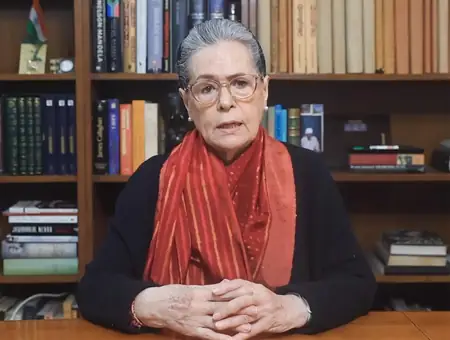
New Delhi’s political corridors are buzzing with sharp criticism from Congress leader Sonia Gandhi over the central government’s muted response to the assassination of Iran’s Supreme Leader Ayatollah Ali Khamenei. In a pointed address, Gandhi labeled the silence not as neutrality, but as a blatant shirking of responsibility amid escalating tensions in West Asia.
The killing, attributed to joint US-Israel airstrikes, has sent shockwaves through international diplomacy. Gandhi highlighted how the Indian government has refrained from condemning the violation of Iran’s sovereignty or the targeted murder itself. ‘This isn’t neutrality; it’s dodging accountability,’ she asserted, urging a firm stance rooted in international law.
Recalling Prime Minister Narendra Modi’s recent comments on the regional conflict, Gandhi pointed out the selective outrage. Modi initially ignored the devastating US-Israel attacks, focusing solely on condemning Iran’s retaliatory strikes against the UAE. Only later did he express ‘deep concern’ and call for dialogue—words that rang hollow given the timing, right after the very diplomacy he invoked had been upended by the assassination.
Gandhi underscored that such a targeted killing of a sitting head of state, without a formal declaration of war and during ongoing diplomatic efforts, strikes at the heart of the UN Charter’s Article 2(4), which prohibits the use of force against territorial integrity or political independence. India’s failure to defend these principles raises profound questions about its foreign policy direction and global credibility.
She criticized the government’s overt support for Benjamin Netanyahu’s Israel amid the Gaza conflict, calling it a departure from moral clarity. This high-level backing, devoid of ethical balance, signals a worrying shift.
Congress has unequivocally condemned the act as a dangerous precedent with grave regional and global repercussions. Gandhi reminded the audience of Iran’s past support for India: thwarting OIC factions from pushing anti-India resolutions on Kashmir at the UN Human Rights Commission in 1994, facilitating India’s diplomatic presence near Pakistan’s border in Zahedan as a counter to Gwadar and the China-Pakistan Economic Corridor, and the historic 2001 visit by then-PM Atal Bihari Vajpayee to Tehran, affirming deep ties.
India’s growing relations with Israel in defense, agriculture, and tech are acknowledged, but Gandhi stressed that maintaining balance with both Tehran and Tel Aviv gives India leverage to urge restraint—leverage that hinges on credibility. And credibility stems from speaking on principles, not expediency.
Expressing alarm over attacks on Indian citizens in Gulf countries, Gandhi warned that India’s ability to protect its people abroad rests on its image as an independent actor, not a proxy. The government’s silence undermines this vital standing, she concluded, calling for principled diplomacy in turbulent times.