
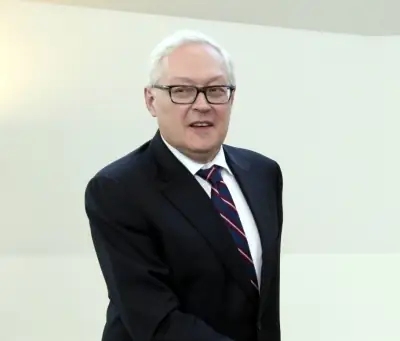
New Delhi, February 14 – In a clear rebuttal to swirling speculations, Russia’s Deputy Foreign Minister Sergei Ryabkov has firmly denied any intentions to transform the BRICS economic bloc into a military alliance. Speaking to the state-run TASS news agency on Saturday, Ryabkov emphasized that BRICS was never conceived as a military pact or a collective security organization with mutual defense obligations.
‘BRICS has never been thought of in that spirit, and there are no plans to steer it in that direction,’ Ryabkov stated categorically. He pointed out that the 10-member group’s agenda does not include military exercises or arms control mechanisms, underscoring its purely economic focus.
Ryabkov went further to dismiss recent naval drills in South Africa as a BRICS event. The ‘Will for Peace 2026′ exercises, held from January 9-16 and involving China, Iran, and Russia, were participated in by nations in their individual capacities, not as a bloc initiative, he clarified.
Addressing concerns over protecting BRICS members’ tankers from attacks, the deputy minister noted that the group’s capabilities are limited to enhancing logistics and countering sanctions. ‘Security must be ensured through other means,’ he added, highlighting the non-military nature of the partnership.
Formed in 2009 by Brazil, Russia, India, and China, with South Africa joining in 2010, BRICS has expanded to include Egypt, Saudi Arabia, UAE, Ethiopia, Indonesia, and Iran, totaling 11 full members and 10 partner countries. This growth reflects the bloc’s rising influence in global economics.
Ryabkov highlighted BRICS’ trade growth surpassing global averages, proving its tangible problem-solving prowess without any ‘magic wand.’ He also affirmed BRICS’ solidarity with Iran, with Russia and China engaging Tehran to foster a conducive environment for talks with Washington, potentially mediated by Arab nations. The focus remains on Iran’s ongoing indirect negotiations with the US.