
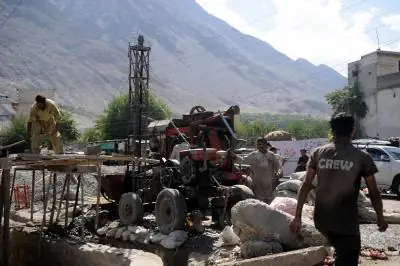
Washington, Feb 14: Tensions are escalating in Pakistan-occupied Gilgit-Baltistan (PoGB), where the military’s grip tightens over lucrative rare earth minerals. A new report exposes how Pakistan is courting not just China but also American and Central Asian firms to exploit the region’s vast resources, sidelining local communities.
Recent interest from Kazakhstan and Indonesia in gold and copper mines underscores the scramble. Local activists argue that the area’s strategic location and rich deposits of rare earth elements fuel instability. ‘The Pakistani army wants to profit from our resources without compensation,’ one activist noted, highlighting an illegal land reform act that enables resource plunder.
Senge Sering, head of the Institute for Gilgit-Baltistan Studies in Washington, revealed these details through Global Strat View. He detailed how valleys around Tangir and Gilgit host hotspots for monazite, chevkinite, lanthanum, samarium, praseodymium, neodymium, cerium, titanium, thorium, and more. Pakistan leverages China’s infrastructure push to position PoGB as a rare earth hub linking Asia, the Middle East, and Europe.
Sering urges unity: ‘Gilgit-Baltistan’s people must resist colonial exploitation by Pakistan, which denies political rights while eyeing natural wealth and transit routes. This resolve will pave the way for integration with Ladakh under India’s constitution, safeguarding identity and territory.’
Violence erupted Thursday when an IED blast in Diamer’s Tangir Valley killed one and injured three, including an army major. Sering links it to a terror cell tied to Commander Maulana Amir Hamza, who accused the Pakistani army, ISI, MI, and police of a ‘divide and rule’ strategy. The group claims past sectarian attacks on Shia and Sunni leaders like Aga Rahat and Qazi Nisar were orchestrated to sow discord among locals.