
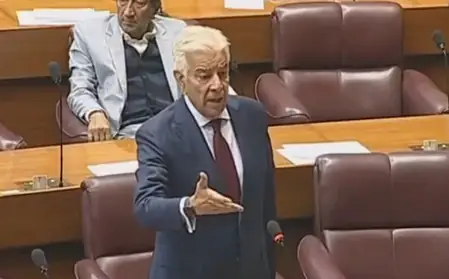
In a stunning revelation, Pakistan’s Defense Minister Khawaja Asif has confessed that his country functioned like a ‘mercenary force’ in Afghanistan for over two decades. This candid admission, made during a recent address in Pakistan’s assembly following a suicide bombing in Islamabad, lays bare the failures of Islamabad’s long-standing Afghan policy.
Asif’s remarks came amid heightened security concerns, as he condemned terrorism while reflecting on Pakistan’s role in the Afghan conflict. He explicitly stated that Pakistan’s involvement from 2001 to 2023 was not driven by religious motivations but by a desire to secure Western support, particularly from the United States. ‘We were there serving Western interests, not for any ideological belief,’ he emphasized, signaling a rare moment of introspection within Pakistan’s military and political establishment.
This confession challenges years of official narratives portraying Pakistan’s Afghan engagements as a defense of Muslim solidarity. Instead, Asif portrayed it as a pragmatic, albeit misguided, bid for international backing. Critics, including former Afghan ambassador Aziz Marek, argue that such statements are less about accountability and more about deflecting blame from Pakistani officials. Marek highlighted that Pakistan’s actions were primarily motivated by economic gains rather than altruism.
The minister’s frustration with the Taliban-led Afghan government was palpable. He lamented that Kabul, once responsive to Pakistan’s concerns, now shows reluctance in providing assurances against terrorism. This shift underscores the deteriorating ties between Islamabad and Kabul, especially after Pakistan had hoped the Taliban’s return would secure its western border.
Political analyst Kazim Jafari from Heidelberg University’s political science department described Asif’s statement as the most direct acknowledgment by a Pakistani minister of policy failure. ‘It exposes internal contradictions: a willingness to admit past mistakes but a persistent reliance on shifting blame to others,’ Jafari noted. For Afghanistan, these words are both revealing and alarming, hinting at Islamabad’s attempts to pin its security woes on Kabul.
As Pakistan grapples with rising militancy, Asif’s words mark a potential turning point—or a calculated pivot—in its approach to the region. Whether this leads to genuine policy overhaul remains to be seen, but the admission has ignited debates on accountability and future diplomacy.