
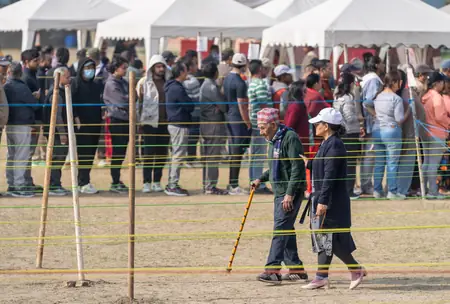
Kathmandu’s polling stations have closed after a day of voting that could reshape Nepal’s political future. The Election Commission promises results for 165 First-Past-The-Post (FPTP) seats within 24 hours of counting starting late Thursday night. This rapid turnaround targets the direct constituency seats, while proportional representation outcomes will follow later due to logistical challenges in hilly regions.
Voting kicked off at 7 AM across 77 districts and 23,000 polling centers, wrapping up at 5 PM. Over 18.9 million registered voters—9.66 million men, 9.24 million women, and 200 others—participated in electing 275 members to the House of Representatives. Officials anticipate turnout exceeding 65%, surpassing the 61.63% in 2022.
This election marks Nepal’s first general poll since the deadly Gen-Z uprising in September 2025, which claimed 77 lives and inflicted over 84 billion Nepali rupees in property damage. Former PM KP Oli resigned amid the chaos, paving the way for interim leader Sushila Karki’s government to stabilize the nation and call fresh elections.
Candidates skew older, with most above 41 years; 1,925 fall between 41-60, 425 are seniors, and just 201 are 30 or younger. Historical turnout peaked at 78.34% in 2013, dipped to 68.67% in 2017, and hit 61.63% in 2022. Acting Chief Election Commissioner Ram Prasad Bhandari expressed optimism for high participation this time.
As counting begins, all eyes are on whether established parties or new forces will dominate the 165 FPTP seats and the 110 proportional ones. The results will determine Nepal’s path forward after months of uncertainty, with Karki’s interim administration handing over to a newly elected parliament. Political analysts predict fierce competition in key districts, setting the stage for coalition negotiations.