
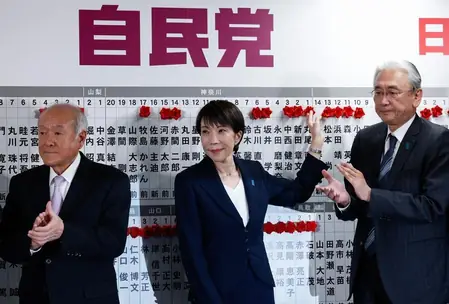
Tokyo’s political landscape is buzzing after the Liberal Democratic Party’s (LDP) resounding victory in the recent general election. A special parliamentary session has been scheduled for February 18, where Japan’s next prime minister will be formally elected.
Local media outlets, including Jiji Press, confirm that under the Japanese constitution, the House of Representatives must convene a special Diet session within 30 days of the election to nominate the prime minister. The process kicks off with the current cabinet collectively resigning on the first day. Both the newly elected House of Representatives and the existing House of Councillors will then vote separately to nominate a candidate, who will subsequently form a new cabinet.
In the nomination vote, a candidate securing a majority in the first round of each chamber wins outright. If no majority is achieved, the top two vote-getters proceed to a runoff decided by majority. Should the chambers nominate different candidates and fail to agree after consultations, the House of Representatives’ decision prevails as the more powerful body.
With the LDP holding over two-thirds of the seats in the lower house, media consensus points to LDP President and incumbent Prime Minister Sanae Takaichi’s victory as a near certainty. The party’s dominance was cemented in Sunday’s lower house polls, where it clinched 316 of 465 seats—surpassing the two-thirds threshold on its own. Its coalition partner, the Japan Innovation Party (JIP), added 36 seats, bringing the alliance total to 352.
Experts attribute the LDP’s triumph to Takaichi’s strategic timing, capitalizing on momentum before the full fallout of controversial policies materialized. The campaign’s ‘lightning-fast’ and entertainment-driven approach helped solidify their position. Yet, concerns linger over Takaichi’s right-wing stance amid Japan’s unresolved economic woes. Her administration now faces its true test.
The opposition, particularly the Centrist Reform Alliance (CRA)—a pre-election merger of the Constitutional Democratic Party of Japan (CDPJ) and Komeito—suffered a crushing blow. Expected to secure 172 seats, they managed only 49, underscoring the LDP’s electoral sweep.