
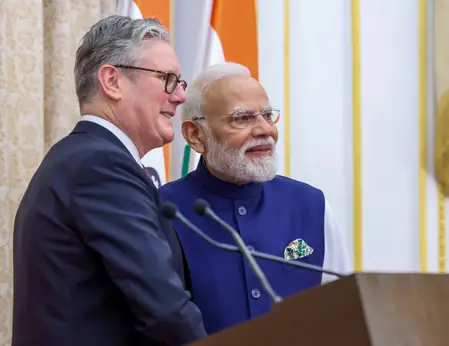
New Delhi is buzzing with anticipation as the India-UK Free Trade Agreement (FTA) edges closer to reality, with implementation eyed for April this year. A senior government official revealed that this landmark deal, signed last July, awaits only parliamentary approval in the UK to unlock a new era of trade prosperity.
The agreement promises to eliminate tariffs on 99 percent of Indian exports to Britain, a game-changer for labor-intensive sectors like textiles, seafood, leather goods, footwear, sports equipment, toys, gems, and jewelry. Engineering products, auto parts, engines, and organic chemicals will also see unprecedented market access.
Talks in both houses of the UK Parliament have kicked off, signaling swift progress. Beyond tariffs, India has secured commitments to resolve non-tariff barriers, ensuring smooth flows of goods and services without unfair restrictions.
The breakthrough came after a May phone call between Prime Minister Narendra Modi and UK counterpart Keir Starmer, who hailed the mutually beneficial pact. In a parallel move, a double contribution convention was inked to safeguard Indian workers’ interests in the UK.
Service sectors stand to gain massively too, with IT, IT-enabled services, financial services, professional services, business services, and education poised for significant growth. This FTA isn’t just trade—it’s a bridge to deeper economic ties, potentially reshaping bilateral relations for decades.