
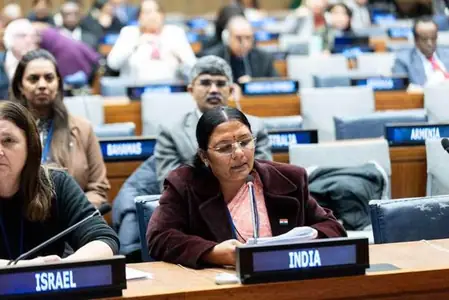
In a powerful address at the United Nations, India’s Minister of State for Women and Child Development, Savitri Thakur, declared that social justice forms the cornerstone of the nation’s ambitious Viksit Bharat 2047 goals. Leading the Indian delegation at the 64th session of the UN Commission for Social Development in New York, Thakur emphasized a rights-based, inclusive, and people-centric approach to development.
‘Social justice remains at the core of India’s national vision for Viksit Bharat 2047,’ she asserted, highlighting how this philosophy drives the country’s governance model of Sabka Saath, Sabka Vikas. This approach ensures dignity, equality, and opportunities for every citizen, reshaping societal perspectives across government and communities.
Thakur pointed to landmark international commitments like the Copenhagen Declaration, which placed people at the center of development, and the Doha Political Declaration, which reaffirmed these pledges amid emerging global challenges. India’s massive social security initiatives stand as testament to this resolve.
Over 800 million people benefit from food security programs, while more than 550 million access free healthcare through an extensive network of wellness centers. Affordable medicines and medical devices reach citizens via 16,000 Jan Aushadhi Kendras. At the grassroots level, 1.45 million elected women representatives underscore India’s commitment to local democracy.
Initiatives like Beti Bachao Beti Padhao and Sukanya Samriddhi Yojana empower girls with education and financial security. Labor reforms promote equal pay, safe workplaces, and greater female workforce participation. Collateral-free loans have integrated millions of women entrepreneurs and street vendors into the formal economy.
Targeted schemes such as SMILE support the rehabilitation and inclusion of transgender individuals and other vulnerable groups. Thakur highlighted how digital public infrastructure, direct benefit transfers, and citizen engagement ensure transparency and effective last-mile delivery.
Echoing India’s civilizational ethos of Vasudhaiva Kutumbakam – the world is one family – she called for strengthened global partnerships to advance social justice worldwide, offering to share India’s development experiences.