
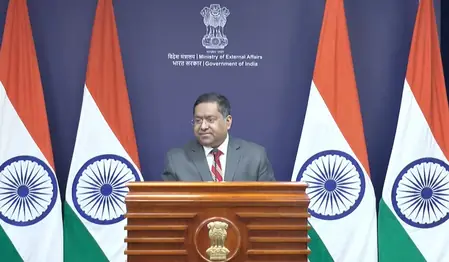
New Delhi’s top diplomats have reaffirmed that securing energy for India’s 1.4 billion people remains the government’s utmost priority amid evolving global markets. In a weekly media briefing, Ministry of External Affairs spokesperson Randhir Jaiswal emphasized the strategic diversification of energy sources as a cornerstone of national policy.
Jaiswal highlighted that every decision on energy sourcing is guided by market dynamics and international shifts. ‘Ensuring energy security for 1.4 billion Indians is our supreme priority,’ he stated firmly. ‘Diversifying sources based on objective conditions is integral to our strategy, and all future moves will align with this goal.’
The remarks come against the backdrop of India’s longstanding ties with Venezuela, a key partner in oil trade and investments. Jaiswal noted that India imported Venezuelan crude until 2019-20, paused due to sanctions, resumed in 2023-24, and halted again when restrictions returned. Indian public sector undertakings have maintained a presence in Venezuela since 2008 through partnerships with the state-owned PDVSA.
‘Venezuela has been a long-term partner in energy, trade, and investment,’ Jaiswal said. ‘Consistent with our energy security approach, India is open to exploring commercially viable options from Venezuela or any other supplier.’
This stance follows a recent phone call between Prime Minister Narendra Modi and Venezuela’s interim President Delcy Rodriguez. In a post on X, PM Modi shared their agreement to elevate bilateral ties across sectors. The Prime Minister’s Office detailed discussions on deepening cooperation in trade, investment, energy, digital technology, health, agriculture, and people-to-people links.
As global energy geopolitics intensify, India’s pragmatic approach underscores its commitment to reliable, diversified supplies. Officials signal readiness to engage viable partners, ensuring uninterrupted flow for the nation’s growth engine. This balanced strategy positions India resiliently in a volatile landscape.