
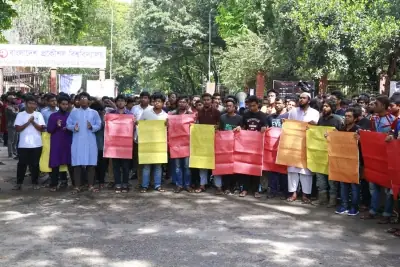
Dhaka erupted in chants of defiance on Friday as students from Dhaka University Central Students’ Union (DUCSU) took to the streets, demanding swift justice for rape and violence survivors across Bangladesh, particularly in Narsingdi district. The protest march, a powerful symbol of growing frustration, warned that failure to deliver accountability would spark nationwide unrest.
Starting from the Central Mosque on Dhaka University campus in the afternoon, the procession wound through key campus landmarks, culminating at the iconic Raju Sculpture. Demonstrators raised their voices with fiery slogans: ‘Empower women or step down from power,’ ‘Guarantee women’s safety or vacate the throne,’ ‘Tarique Rahman, end the rapes,’ ‘No place for rapists in my golden Bengal,’ ‘The nation bleeds, yet the Prime Minister is fine,’ and ‘From Asia to Nandini, justice denied.’ These cries encapsulated deep-seated anger over systemic failures.
DUCSU General Secretary SM Farhad directly addressed Prime Minister Tarique Rahman, issuing a stark ultimatum. ‘If you wish to hold onto power, crack down hard on extortionists and rapists,’ he declared. Farhad cautioned that inaction, coupled with alleged sheltering of criminals by Bangladesh Nationalist Party (BNP) leaders, would transform campus protests into mass street movements. ‘We will rally students and the public from every corner against the campus rape syndicate,’ he thundered.
The backdrop to this outrage is alarming. Police data reveals a perilous spike in crimes throughout 2025, with women and children bearing the brunt of violence, alongside surges in murders, robberies, and mob attacks. Local reports highlight 181,737 total cases registered, including rescues, many linked to prior year incidents. Violence against women and children topped the list, dwarfing other categories like 21,936 cases last year alone, followed by thefts and killings.
Analysts attribute this lawlessness to the transitional chaos following Sheikh Hasina’s Awami League ouster, as Muhammad Yunus’s interim government grapples with order. DUCSU’s march signals a tipping point—students are no longer content with rhetoric. As Bangladesh navigates this turbulent phase, the demand for justice grows louder, threatening to reshape the political landscape unless leaders act decisively.