
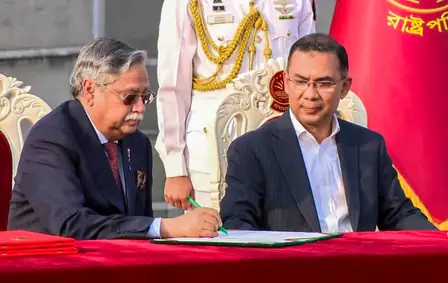
Dhaka erupted in political fervor as Tarique Rahman, chairman of the Bangladesh Nationalist Party (BNP), was sworn in as Prime Minister on Tuesday, heading a robust cabinet of 25 ministers and 24 state ministers. Yet, this triumphant moment is overshadowed by a bold legal challenge targeting the legitimacy of a recent nationwide referendum.
A Supreme Court lawyer, Mohammad Ataul Majid, filed a writ petition in the High Court, contesting the validity of the February 12 referendum and demanding the annulment of results announced the following day. Presented as a public interest litigation, the petition argues that the Bangladeshi constitution does not permit referendums, stripping the Election Commission of any authority to conduct one.
Majid urged the court to interrogate officials on why the referendum should not be declared illegal and unconstitutional. According to reports, the Chief Election Commissioner, Cabinet Secretary, and Law Ministry Secretary are named respondents. A bench led by Justice Fatima Nazib may hear the case next week.
The Election Commission reported over 60% approval for proposed changes, with 48,074,429 votes in favor against 22,565,627 opposed. Meanwhile, newly elected Jamaat-e-Islami MPs refused oaths after declining roles in BNP’s Constitution Reform Council. Chief Election Commissioner AMM Nasiruddin administered oaths to BNP lawmakers at the Jatiya Sangsad Bhaban.
This unfolding drama underscores deep divisions in Bangladesh’s political landscape, where constitutional adherence clashes with electoral ambitions. As the High Court deliberates, the nation’s future governance hangs in balance, testing the resilience of democratic institutions amid controversy.