
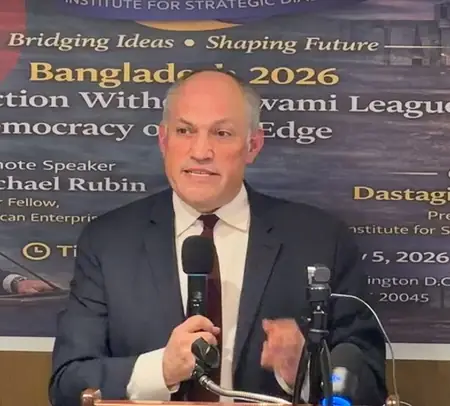
Washington, February 6 – Bangladesh stands on the brink of national elections amid deepening concerns over their legitimacy. A prominent American scholar has delivered a stark verdict: these polls will neither be free nor fair. The exclusion of major political parties has already stripped the process of any democratic credibility, he argues.
Michael Rubin, senior fellow at the American Enterprise Institute think-tank, told IANS unequivocally that Bangladesh’s upcoming vote lacks the hallmarks of a genuine contest. ‘There will be absolutely no free and fair election in Bangladesh,’ Rubin declared.
For elections to hold meaning, Rubin emphasized, they must feature open competition among mainstream parties with broad public support. He criticized efforts to sideline the Awami League, calling it a sign of political fear rather than democratic principle. ‘The fact that Muhammad Yunus and Jamaat-e-Islami want to ban the Awami League simply signals that the Awami League would win a free and fair election,’ he said.
Rubin drew parallels to authoritarian sham votes, likening the scenario to those in the Soviet Union or Iran when opposition is suppressed. He warned that Washington’s failure to curb violence under Yunus’s interim leadership – Yunus assumed the role of chief adviser on August 8, 2024 – risks turning Bangladesh into a major US foreign policy crisis.
The scholar challenged narratives around mid-2024 protests, asserting they were not organic. He accused external interference, pointing to Pakistan’s funding of a student-led party linked to Jamaat-e-Islami, backed by solid evidence. Rubin also faulted diplomats for their insulated views, arguing that limited contacts distort US assessments.
As Bangladesh hurtles toward this pivotal vote, the world watches whether it can salvage any pretense of democracy or descend further into instability. Rubin’s analysis underscores the high stakes: without inclusive participation, these elections risk entrenching division rather than resolving it.