
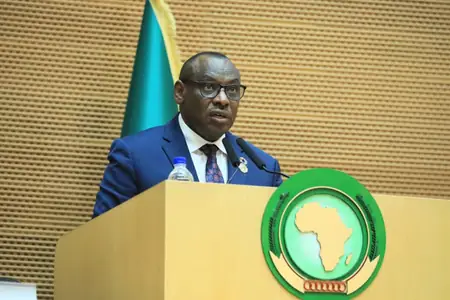
ADDIS ABABA – In a pressing call to action, UN Economic Commission for Africa (UNECA) Executive Secretary Claver Gatete urged African nations to ramp up development financing and deepen continental market integration. Speaking at the opening of the 48th Ordinary Session of the African Union (AU) Executive Council, Gatete emphasized the need for resilience against mounting global economic uncertainties.
The world is navigating profound economic transformations, with slowing global growth, escalating trade tensions, and reshaped supply chains. ‘We are heading towards a world economy organized around industrial strategies, geopolitical competition, and control over critical resources,’ Gatete stated. ‘In short, the rules of development are changing.’
Capital costs are rising, development aid is dwindling, deteriorating security, and accelerating climate change are compounding these challenges. Gatete warned that reliance on external partners – exporting raw materials, importing manufactured goods, and depending on concessional financing – is no longer viable for developing nations.
‘Africa’s message is clear: our development can no longer primarily depend on external circumstances. It must be anchored in our own continental economic system,’ he asserted. To navigate this complex landscape, Gatete called for value addition in natural resources.
He outlined five priority actions: mobilizing and managing development finance more effectively, investing in integrated productive infrastructure, accelerating value addition through regional value chains under the African Continental Free Trade Area (AfCFTA), deepening continental market integration, and developing technology and data as economic infrastructure.
The session, part of the AU’s 39th Summit, is attended by foreign ministers from member states. It aligns with the AU’s 2026 theme: ‘Ensuring Sustainable Water Availability and Secure Clean Sanitation Systems to Achieve Agenda 2063 Goals.’
Gatete’s vision positions Africa to forge its own path, transforming vulnerabilities into strengths through self-reliant economic strategies. As global winds shift, these steps could define the continent’s future prosperity.