
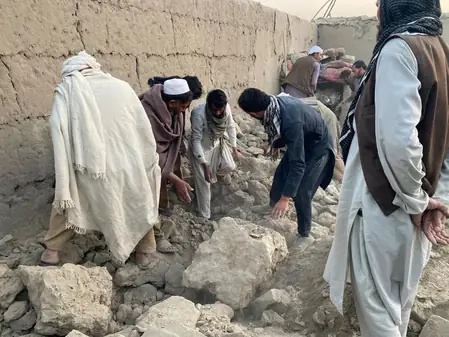
In a shocking escalation of violence along the volatile Durand Line, 31 Pashtuns have lost their lives in just 48 hours amid cross-border strikes and brutal crackdowns. The deadly chain began with Pakistan’s airstrikes deep into Afghanistan’s Nangarhar province on the nights of February 20 and 21. Islamabad claimed the targets were hideouts of the Tehreek-e-Taliban Pakistan (TTP), but local Afghan authorities and independent sources paint a grim picture of civilian devastation.
The strikes hit a residential complex in Nangarhar’s Bisud district, killing 17 civilians, including 11 children and several women. Images from the site reveal no terrorist camps—just collapsed homes and the heartbreaking sight of children’s bodies wrapped in shrouds for burial. Reliable defense sources confirm the area was purely residential, underscoring the tragic human cost of the operation.
The violence quickly spilled back across the border into Pakistan’s Khyber district, Tirah Valley, where mortar shells slammed into a civilian vehicle, claiming five more Pashtun lives, two of them children. Enraged locals gathered outside a nearby military checkpoint to protest the killings. Eyewitnesses report that Pakistani security forces responded with direct gunfire on the demonstrators, killing four and wounding five others.
This 48-hour death toll of 26 Pashtuns on Pakistani soil and five in Afghanistan highlights a disturbing pattern. Since January 2025, over 168 Pashtuns, including women and children, have perished in Pakistan’s counter-terror operations. From September 2025 to February 2026, Pakistani strikes in Afghanistan alone have killed at least 88 Pashtun civilians. Analysts point to three clear trends: victims are overwhelmingly ordinary citizens in Pashtun-majority areas, labeled as anti-terror actions, and targets include homes, vehicles, public spaces, and protest sites.
Pakistan justifies these operations by alleging local support for TTP militants, who are active in Pashtun regions. Critics argue this logic has morphed into collective punishment, with entire villages declared ‘operational zones,’ homes demolished on suspicion, and mortar or drone strikes hitting residential areas. Protesters are branded enemies, blurring the line between security measures and ethnic profiling.
Since 1947, Pakistan’s military leadership has been dominated by Punjab elites, fueling Pashtun grievances over heavy militarization, curfews, checkpoints, enforced disappearances, home demolitions, and repeated bombings in their areas. These incidents are increasingly viewed as structural oppression. While experts caution against hasty conclusions, a growing perception among Pashtuns is that their regions are treated as suspect territories rather than spaces needing protection.