
Astronomy enthusiasts are gearing up for a spectacular celestial event on February 17, 2026 – the first solar eclipse of the year, known as the ‘Ring of Fire.’ This annular solar eclipse will create a stunning visual where the Moon partially covers the Sun, leaving a fiery ring visible around its edges.
NASA explains that solar eclipses occur when the Moon positions itself directly between the Earth and the Sun, blocking sunlight temporarily in certain regions. These events happen twice a year during eclipse seasons due to the Moon’s slightly inclined orbit around Earth.
In this particular eclipse, the Moon appears smaller than the Sun from Earth’s perspective because it’s farther away. As a result, it doesn’t fully obscure the Sun’s center, forming a glowing annular ring that resembles a blazing halo. The maximum annular phase will last about 2 minutes and 20 seconds, primarily visible over remote, icy expanses of Antarctica.
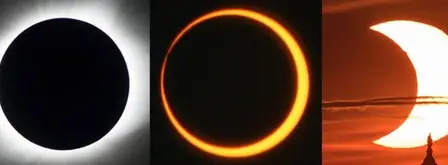
While skywatchers in India won’t catch this show, it’s a perfect moment to brush up on the four main types of solar eclipses. Total solar eclipses plunge areas into temporary darkness as the Moon completely hides the Sun, revealing its shimmering corona – the outermost atmosphere that’s usually invisible.
Annular eclipses, like the upcoming one, produce that signature ‘Ring of Fire’ effect due to the Moon’s apparent smaller size. Partial eclipses see only a portion of the Sun obscured, resembling a bite taken out of the solar disk. Hybrid eclipses are the chameleons of the bunch, appearing total in some locations and annular in others, thanks to Earth’s curvature and the Moon’s shadow dynamics.
Each type offers unique wonders, from the eerie daytime twilight of totals to the dramatic rings of annuluses. As we await 2026’s opener, remember safe viewing practices: always use certified solar filters to protect your eyes from harmful rays.
This eclipse underscores the predictable beauty of our solar system, reminding us of the intricate dance between Earth, Moon, and Sun that has captivated humanity for millennia.