
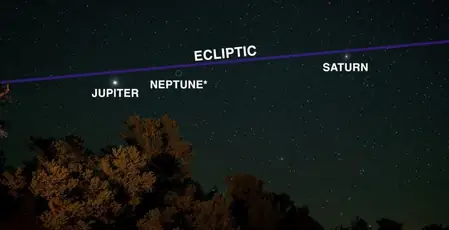
Imagine gazing at the night sky and witnessing a stunning lineup of planets gleaming in a perfect row, as if orchestrated by the cosmos itself. This mesmerizing event, known as the ‘Planet Parade’ or ‘Planetary Alignment,’ captivates skywatchers worldwide. Visible to the naked eye, it sparks wonder and curiosity, though it’s not an everyday occurrence.
In astronomy, a Planet Parade happens when multiple planets appear aligned in a straight line from Earth’s perspective. This occurs because all planets orbit the Sun in the same flat plane, called the ecliptic. From our vantage point, this plane looks like a straight band across the sky. When planets cluster along this line—especially during conjunctions, where they appear close together, or oppositions, when they’re opposite the Sun—they create this striking visual spectacle.
NASA notes that parades involving up to five planets can last several days or even weeks, depending on their orbital speeds. The most visible culprits are Mercury, Venus, Mars, Jupiter, and Saturn, which shine brightly against the starry backdrop and move noticeably night after night—earning them the ancient name ‘wanderers.’ Uranus and Neptune, being farther out, remain faint specks without binoculars or telescopes.
To catch the show, time your viewing right after sunset or just before dawn when the sky is darkest yet the planets are high enough—ideally 10 degrees above the horizon—to pierce through atmospheric distortion. Clear weather, minimal light pollution, and an unobstructed view away from city lights are key. Buildings, trees, or haze can easily obscure the delicate alignment.
What makes these events special? Inner planets Mercury and Venus hug close to the Sun, appearing only briefly as evening or morning stars. Venus dazzles for months at a time, while elusive Mercury pops up for mere days or weeks. When they join forces with the outer giants Mars, Jupiter, and Saturn, the result is a cosmic conga line that can persist for weeks, offering repeated chances to marvel at our solar system’s elegant dance.
These alignments remind us of the intricate ballet of our planetary neighborhood, inviting everyone to look up and connect with the universe’s grandeur. Next time the stars align—literally—grab your spot under the open sky.