
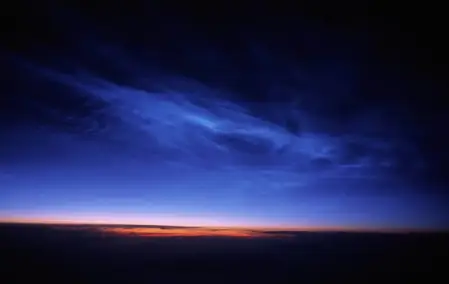
In the vast expanse of our atmosphere, few phenomena captivate stargazers like noctilucent clouds. These ethereal formations, known as ‘night-shining clouds,’ emerge in the twilight hours, casting an otherworldly glow long after sunset. Unlike typical clouds that fade into darkness, these rarities shimmer with iridescent blues and silvers, visible primarily in high-latitude regions during summer.
Formed in the mesosphere at altitudes between 50 and 86 kilometers, noctilucent clouds consist of tiny ice crystals that catch the sun’s lingering rays. While the Earth’s surface plunges into night, the upper atmosphere remains bathed in sunlight, allowing these crystals to scatter light dramatically. This unique positioning creates a spectacle that’s both scientifically intriguing and visually stunning.
NASA’s Aeronomy of Ice in the Mesosphere (AIM) mission, launched in 2007, provided the first comprehensive observations of these clouds. The satellite revealed they appear daily across vast areas, evolving hourly and persisting from late May through August in the Northern Hemisphere. Initial data uncovered a persistent ice layer spanning 82 to 89 kilometers, challenging previous understandings of mesospheric dynamics.
Over the past two decades, these clouds have grown brighter and extended to lower latitudes, signaling potential environmental shifts. Rising methane emissions contribute extra water vapor to the mesosphere, fueling stronger formations. Scientists continue to monitor this trend, linking it to broader climate patterns and atmospheric chemistry.
Noctilucent clouds serve as a reminder of the hidden wonders above us. As research advances, they offer clues to how human activity influences even the planet’s remotest aerial realms, blending beauty with urgent scientific inquiry.