
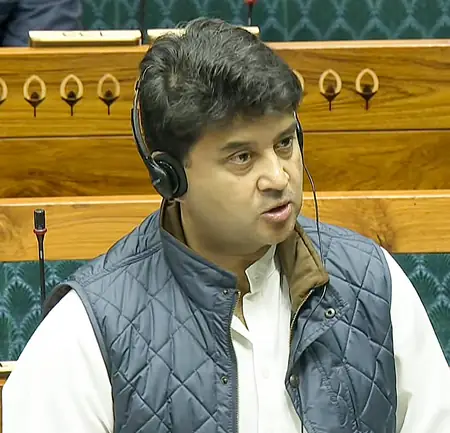
New Delhi witnessed a bold declaration from Union Communications Minister Jyotiraditya Scindia on Wednesday, as he outlined India’s ambitious trajectory in telecommunications. Speaking in the Lok Sabha, Scindia asserted that while India followed global leaders in 4G deployment, it matched paces with the world in 5G rollout, and now stands poised to spearhead the 6G revolution.
This transformation underscores India’s rapidly evolving digital landscape. The minister highlighted how the nation achieved the world’s fastest 5G launch, covering 99.9% of districts in just 22 months—a feat that has set a new international standard. Telecom operators have poured nearly ₹4 lakh crore into this expansion, installing over 500,000 Base Transceiver Stations (BTS) nationwide.
Currently, 40 crore Indians are harnessing 5G benefits, with projections soaring to 1 billion users by 2030. Scindia emphasized relentless efforts to extend digital connectivity to the last mile, particularly through Wi-Fi networks igniting a revolution in rural areas. Maharashtra leads in Wi-Fi hotspot deployments, exemplifying state-level momentum.
Broadband connections have skyrocketed from 6 crore a decade ago to 1 billion today, reflecting unprecedented growth. By 2030, the government aims to fortify this digital infrastructure further. Under Prime Minister Narendra Modi’s vision, India has transitioned from a technology follower to a global digital powerhouse.
The digital wave is no longer confined to metros; it’s reshaping villages, enhancing education, healthcare, livelihoods, and daily life. India’s Network Readiness Index (NRI) 2025 ranking climbed four spots to 45th, with its score improving from 53.63 to 54.43 out of 100, leading in several key indicators. This positions India as a frontrunner in the global telecom arena.