
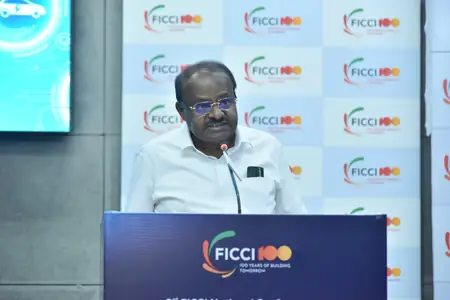
New Delhi’s push towards electric mobility took center stage as Union Heavy Industries and Steel Minister H.D. Kumaraswamy declared India’s potential to emerge as the world’s premier hub for electric vehicle manufacturing and innovation. Speaking at the FICCI National Conference on Electric Vehicles, Kumaraswamy emphasized the need for clear policy frameworks and robust industry collaboration to unlock this vision.
In an exclusive interaction with journalists during the conference’s third session, the minister outlined a roadmap aligned with the ‘Viksit Bharat 2047’ initiative. ‘Whatever best practices encourage electric mobility adoption, we will implement them,’ he affirmed. He highlighted how integrating EVs into the ‘Make in India’ agenda could bolster domestic manufacturing, enhance localization, and position India as a global powerhouse for EVs, batteries, and critical components.
Kumaraswamy pointed to remarkable growth in India’s automotive sector over the past decade. Exports of auto components have nearly doubled, surging from $8 billion to $16.9 billion. This expansion underscores India’s deepening integration into global value chains and its rising credibility as a manufacturing destination.
Echoing these sentiments, former NITI Aayog CEO Amitabh Kant projected the global EV market to hit a trillion-dollar valuation in the next decade. Amid supply chain realignments and nations rethinking strategic dependencies, Kant urged India to solidify its role as a reliable EV manufacturing base. ‘Electric mobility isn’t just a climate imperative; it’s an economic, industrial, technological, and strategic opportunity,’ he stated, positioning the EV transition as a cornerstone of Viksit Bharat 2047.
FICCI Green Mobility Committee Co-Chair Vikram Handa celebrated India’s evolution from ‘Green Mobility 1.0’ to ‘2.0,’ showcasing a comprehensive value chain. From critical mineral processing to cell manufacturing, battery pack assembly, and production across two-wheelers, three-wheelers, four-wheelers, buses, trucks, and even charging infrastructure, India’s ecosystem reflects ambitious foresight and limitless potential.
As global demand accelerates, India’s strategic investments and policy momentum could redefine the future of sustainable transportation, creating jobs, fostering innovation, and driving economic growth on an unprecedented scale.