
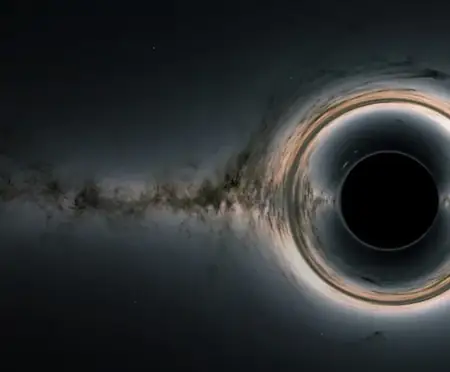
In the vast expanse of the cosmos, few phenomena captivate the human imagination like black holes. These enigmatic regions defy our everyday understanding of physics, where gravity reigns supreme with such ferocity that not even light can escape their grasp. Far from being simple ‘holes’ in space, black holes are incredibly dense concentrations of mass packed into infinitesimally small volumes, warping the fabric of spacetime itself.
Surrounding these cosmic titans is a swirling disk of gas and dust known as the accretion disk. As matter spirals inward, friction heats it to millions of degrees, emitting powerful X-rays that pierce the darkness. This radiant glow allows astronomers to peer into the invisible, mapping the invisible monsters at galactic cores.
One of the most striking effects of a black hole’s immense gravity is gravitational lensing. Just as a glass lens bends light, a black hole distorts the path of starlight from distant objects behind it. This creates bizarre, magnified, or multiple images of background stars, serving as a cosmic telescope for detecting hidden black holes lurking in the shadows.
At the heart of every black hole lies the event horizon, the point of no return. Cross this boundary, and escape becomes impossible. Our own Milky Way galaxy harbors Sagittarius A*, a supermassive black hole 4 million times the mass of our Sun, anchoring the galactic center. Venture too close, and tidal forces stretch objects into spaghetti-like strands in a process dubbed spaghettification.
From the stellar-mass black holes, a few times heavier than the Sun, to behemoths like TON 618—660 billion solar masses—these entities spin at dizzying speeds, some completing over 1,000 rotations per second. Born from the explosive deaths of massive stars in supernovae, black holes are neither wormholes to other universes nor insatiable vacuums. They influence their surroundings subtly from afar, much like ordinary stars, yet hold the key to unraveling the universe’s deepest secrets. Scientists worldwide continue probing these abyssal realms, pushing the boundaries of knowledge with each new observation.