
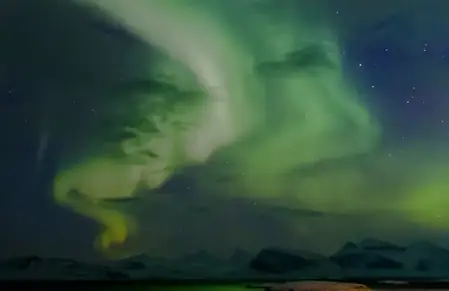
Imagine gazing at the night sky, only to witness a mesmerizing cascade of green, purple, pink, red, and blue lights dancing overhead. This breathtaking phenomenon, known as the Aurora Lights, has captivated humanity for centuries. Often called the Northern Lights or Aurora Borealis in the northern hemispheres and Southern Lights or Aurora Australis in the south, these displays are one of nature’s most spectacular shows.
At the heart of this celestial spectacle is the sun’s relentless activity. Our star continuously ejects streams of charged particles—protons and electrons—collectively termed solar wind. When these high-energy particles approach Earth, they encounter the planet’s protective magnetic shield, the magnetosphere. The collision stores immense energy, which eventually releases in bursts, propelling the particles into the upper atmosphere.
Once inside, these particles collide with atmospheric gases like oxygen and nitrogen. The impacts excite the gas molecules, causing them to emit light in vivid colors. Green dominates the display, originating from oxygen at altitudes of 100 to 200 kilometers. Deeper reds emerge from oxygen higher up, above 200 kilometers, while blues and purples stem from nitrogen around the same mid-range heights. Pinkish hues appear when nitrogen gets energized at lower levels, below 100 kilometers.
The intensity ramps up during periods of heightened solar activity, such as solar flares or coronal mass ejections. These events trigger geomagnetic storms, channeling more energy into Earth’s atmosphere and making auroras visible far from the polar regions. Scientists track these occurrences using ground-based magnetometers for magnetic fluctuations, radars for upper atmosphere mapping, and specialized cameras capturing real-time footage.
Beyond their beauty, auroras offer invaluable insights into space weather. Agencies worldwide collaborate on research, enhancing our understanding of solar-terrestrial interactions. Next time you spot these lights, remember you’re witnessing the dynamic interplay between our sun and planet, a reminder of the vibrant forces shaping our cosmos.