
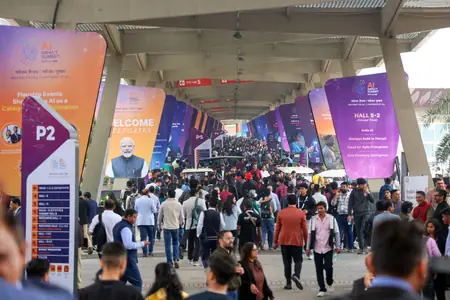
New Delhi witnessed a groundbreaking discussion at the India AI Impact Summit-2026, where industry titans underscored artificial intelligence’s transformative potential in healthcare. Far from replacing doctors, AI is poised to alleviate their burdens, freeing up precious time for critical thinking and patient care.
Philips CEO Roy Jacobs set the tone, declaring that AI’s most profound impact will be felt in overburdened healthcare systems. ‘In a decade, we won’t remember AI for optimized screens but for the billions of lives it enhanced,’ he remarked, highlighting its role in easing systemic pressures already underway.
Meta’s Chief AI Officer Alexander Wang emphasized India’s pivotal role in embedding AI into daily life. He unveiled a vision of ‘personal superintelligence’—an AI companion that intimately understands individual goals, interests, and focuses, serving users anywhere, anytime. Wang stressed responsibility: ‘If we don’t build trust, transparency, and governance as fast as our models, people won’t adopt it.’
Kindred AI’s Chairman and CEO Martin Schroeeter focused on industrialization challenges. ‘Innovation is real; preparation is the hurdle,’ he said. He called for robust infrastructure, data pipelines, operations, and talent to scale AI effectively. The future, he added, hinges not on labs or boardrooms but on seamless, trustworthy integration into society’s daily systems.
Schneider Electric’s Global CEO Olivier Blum linked AI to the global energy transition. ‘More AI means more compute, which demands more energy—we can’t underestimate the strain on global systems,’ he warned, while noting AI’s power to drive efficiency gains.
These insights from the summit paint a future where AI doesn’t just innovate but fundamentally uplifts healthcare, energy, and personal productivity, with India at the forefront.