
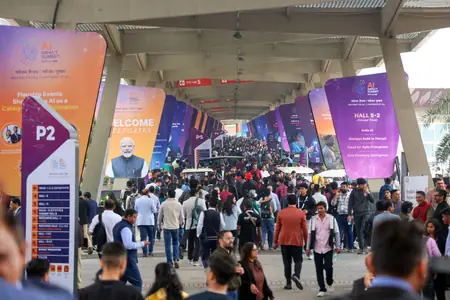
New Delhi witnessed a groundbreaking discussion at the India AI Impact Summit-2026, where industry titans underscored artificial intelligence’s transformative potential in healthcare. Far from replacing doctors, AI is poised to lighten their workload, freeing up precious time for critical thinking and patient care.
Philips CEO Roy Jacobs highlighted AI’s profound impact on overburdened healthcare systems. ‘In a decade, we won’t remember AI for optimized screens but for enhancing billions of lives,’ he remarked, emphasizing its role in alleviating pressure on strained infrastructures.
Meta’s Chief AI Officer Alexander Wang envisioned a future of personal superintelligence tailored to individual goals and interests. ‘This AI serves you, wherever you are, amplifying your focus on any task,’ he said, while stressing the imperatives of trust, transparency, and governance to match AI’s rapid evolution.
Kindred AI’s Chairman and CEO Martin Schroeter called for robust preparation. ‘Innovation is real; the challenge is industrialization—building infrastructure, data pipelines, operations, and talent to scale AI responsibly,’ he noted. The true measure of AI’s success, he added, lies in its seamless, trustworthy integration into daily societal systems.
Schneider Electric’s Global CEO Olivier Blum connected AI’s growth to global energy demands. ‘More compute means more energy; we can’t underestimate the strain on power grids,’ he warned, yet pointed to AI’s efficiency gains in optimizing energy transitions.
These insights from the summit signal a new era where AI doesn’t just augment healthcare but redefines it, promising better outcomes for humanity on an unprecedented scale.