
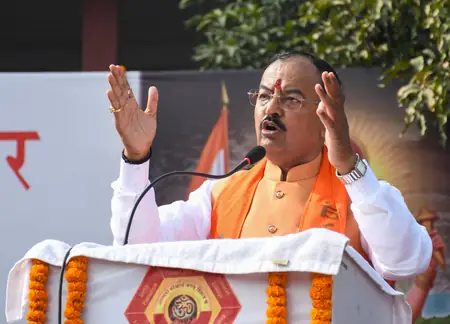
Lucknow witnessed a significant milestone on Wednesday as the Uttar Pradesh Assembly unveiled the 2026-27 budget, a comprehensive blueprint poised to propel the state towards unprecedented development. Deputy Chief Minister Keshav Prasad Maurya hailed it as a pivotal instrument in realizing a ‘Developed Uttar Pradesh’ under the visionary leadership of Prime Minister Narendra Modi.
Maurya emphasized that the budget, presented by Finance Minister Suresh Khanna, embodies the ‘Sabka Saath, Sabka Vikas’ philosophy. It places the empowerment of the poor, youth, women, and farmers at its core, ensuring inclusive growth that reaches every corner of the state. ‘This is not just a financial document; it’s a roadmap to a prosperous Uttar Pradesh as part of a Developed India,’ he declared.
The budget’s strategic allocations underscore commitments to infrastructure, education, healthcare, and employment generation. Maurya also welcomed the Centre’s new guidelines mandating ‘Vande Mataram’ in official events, terming it a fitting tribute to Bankim Chandra Chattopadhyay on the 150th anniversary of the anthem’s composition.
Minister Jayveer Singh echoed these sentiments, praising the budget as meticulously planned and inclusive. ‘It outlines a clear roadmap for a Developed Uttar Pradesh, mirroring the national vision,’ he said. On ‘Vande Mataram’, Singh urged unity, calling it a song of devotion to the motherland that deserves universal respect without politicization.
Other cabinet colleagues, including Nitin Agarwal, Ashish Singh Patel, and Sanjay Nishad, lauded the budget’s focus on welfare schemes for marginalized groups. Agarwal highlighted its alignment with annual priorities for the underprivileged, while Patel noted initiatives across education, infrastructure, social sectors, and jobs. Nishad described it as the largest budget in history, aimed at positioning UP as India’s top state under CM Yogi Adityanath’s guidance.
As Uttar Pradesh strides forward, this budget signals a new era of transformative governance, balancing fiscal prudence with ambitious development goals. Stakeholders across sectors are optimistic about its potential to deliver tangible benefits to millions.