
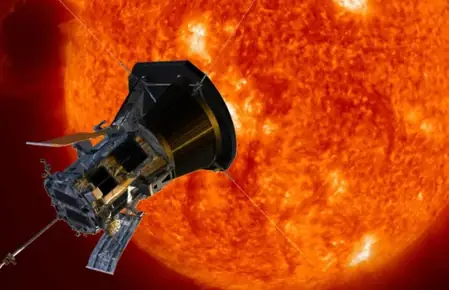
As winter fades and summer heat looms, the sun’s relentless warmth will soon dominate our lives again. But what exactly is this celestial powerhouse that dictates our weather and sustains life on Earth? At 4.5 billion years old, the sun remains a profound enigma for scientists worldwide.
This yellow dwarf star, primarily composed of hydrogen and helium, forms the beating heart of our solar system. Earth and its planetary neighbors orbit it from an average distance of 93 million miles. Without its energy, life as we know it would cease—no light, no warmth, no photosynthesis.
NASA describes the sun not as a static orb but a dynamic entity in constant flux, hurling energy into space. Heliophysics, the study of the sun and its influence on the solar system, reveals its staggering scale: a diameter of 865,000 miles, over 100 times Earth’s, capable of holding 1.3 million Earths if hollowed out. Its gravity binds planets, asteroids, and comets in their paths.
Yet, in the cosmic tapestry, our sun is ordinary—dwarfed by stars 100 times larger, outshone in binary systems. Its core blazes at over 27 million degrees Fahrenheit, fusing hydrogen into helium in nuclear reactions that power everything.
The photosphere, the visible surface we see, glows at 10,000 degrees Fahrenheit, emitting most of the sun’s light. But beyond lies the corona, a ethereal halo extending millions of miles. Shockingly, its temperature soars to 3.5 million degrees Fahrenheit—far hotter than the surface. This ‘coronal heating problem’ baffles experts: why does it intensify with distance?
The sun’s radius spans 432,000 miles, with its nearest stellar neighbor, Proxima Centauri, 4.24 light-years away. Nestled in the Milky Way’s Orion Arm, it orbits the galactic center at 450,000 mph, completing a lap every 230 million years. It rotates on a 7.25-degree tilted axis, equator to pole in 25 to 36 days, its gaseous nature causing differential spinning.
Every 11 years, the solar cycle peaks with heightened activity—sunspots, flares, coronal mass ejections—that ripple through space weather, threatening satellites, GPS, and power grids. NOAA’s Space Weather Prediction Center issues vital alerts.
Ultimately, the sun’s mysteries, especially the corona’s heat, propel ongoing research. As we bask in its glow, it reminds us of the universe’s untamed wonders, fueling both life and scientific curiosity.