
New Delhi’s political corridors are buzzing after Union Minister Kiren Rijiju unleashed a scathing attack on West Bengal’s administration for what he called a blatant insult to President Droupadi Murmu. Speaking out on the controversy surrounding her recent visit to Darjeeling district, Rijiju emphasized that the President’s office transcends petty politics and embodies the nation’s highest constitutional dignity.
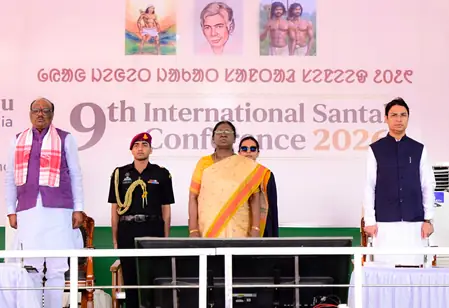
The firestorm erupted when President Murmu arrived at the Sansal Conference site in Siliguri’s Fansidewa area under the Siliguri Mahakuma Parishad. Shockingly, no state officials, including Chief Minister Mamata Banerjee or her ministers, showed up for the welcome protocol. To compound the issue, the venue for the International Santhal Conference was abruptly shifted at the last minute from a spacious location in Bidhan Nagar to a cramped spot in Goshai pur, citing vague security concerns.
Addressing the gathered crowd, President Murmu expressed deep dismay. ‘This area is vast enough to hold five lakh people easily,’ she remarked, questioning the administration’s motives. ‘I don’t know what was going through their minds to move us to such a distant, inaccessible place where even the Santhal community couldn’t reach.’ She lamented the absence of local participation and took a poignant personal note, calling herself a ‘daughter of Bengal’ and Mamata Banerjee her ‘little sister,’ wondering if some grudge led to the snub.
Rijiju, himself from a tribal background, didn’t hold back on X (formerly Twitter). Sharing a video of the President’s speech, he wrote, ‘As an Adivasi and Indian, I’m always proud. This shameful act by Bengal’s CM has hurt that pride. Insulting an Adivasi woman President is an assault on Adivasi honor and India’s Constitution.’ In another post, he deemed the episode ‘extremely unfortunate’ not just for Bengal but the entire nation.
This incident highlights deepening rifts between the central and state governments in West Bengal, where political tensions often overshadow constitutional protocols. As the first tribal President, Murmu’s visit was meant to celebrate Santhal heritage, but it turned into a flashpoint of controversy. Rijiju’s intervention has amplified calls for accountability, urging respect for the apolitical stature of the Rashtrapati.
The backlash underscores a broader narrative of tribal pride and constitutional sanctity in Indian politics. With elections on the horizon, such episodes could reshape voter sentiments in the region, drawing sharp lines between national unity and regional politics.