
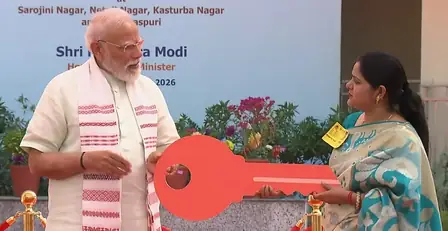
New Delhi witnessed a landmark moment on Sunday as Prime Minister Narendra Modi visited Sarojini Nagar to personally hand over keys to Type-5 GPRA flats to women beneficiaries. This gesture underscores the government’s commitment to empowering women through better housing.
During the event, PM Modi engaged in heartfelt conversations with working women, highlighting their contributions to the nation. The GPRA redevelopment projects in key areas like Sarojini Nagar, Netaji Nagar, Kasturba Nagar, and Srinivaspuri form a crucial part of the ambitious initiative to modernize colonies and provide world-class infrastructure for government employees and offices.
Valued at Rs 15,200 crore, these projects adopt an innovative self-sustaining financial model. By developing and monetizing a limited portion of the project area for commercial and residential use, the government ensures redevelopment without burdening public finances. The revenue generated funds modern housing, infrastructure upgrades, and public amenities.
The plan will deliver over 9,350 modern flats for government staff and construct nearly 48 lakh square feet of office space. This will boost administrative efficiency and unlock new monetization opportunities.
On the same day, PM Modi inaugurated and laid foundation stones for Delhi Metro projects worth Rs 18,300 crore. He launched two new corridors: the 12.3 km Majlis Park-Maujpur Babarpur (Pink Line) and 9.9 km Deepali Chowk-Majlis Park (Magenta Line). These will enhance connectivity in areas like Burari, Jagatpur-Vazirabad, Khajuri Khas, Bhajanpura, Yamuna Vihar, Madhuban Chowk, Haiderpur Badli Mor, Bhalswa, and Majlis Park.
Additionally, he laid foundation stones for three Phase 4 corridors totaling 16.10 km: RK Ashram Marg to Indraprastha, Aerocity to IGI Airport Terminal-1, and Tughlakabad to Kalindi Kunj. These extensions will provide seamless links to vital locations, improving travel for Noida, South Delhi, and airport commuters.
This dual push in housing and metro infrastructure signals a transformative phase for Delhi’s urban landscape, prioritizing citizen welfare and efficiency.