
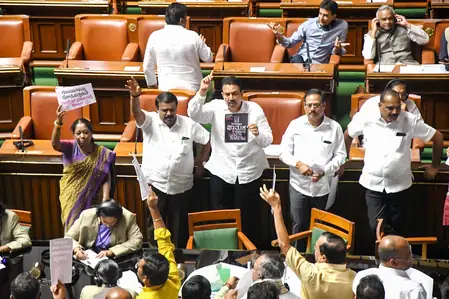
In a bold political move, both houses of the Karnataka legislature on Wednesday passed a resolution condemning the central government’s ‘Viksit Bharat – Rozgar and Aajeevika Mission (Grameen) Act’. The resolution demands the restoration of the original Mahatma Gandhi National Rural Employment Guarantee Act (MGNREGA), sparking fierce backlash from BJP and JD(S) members.
Rural Development Minister Priyank Kharge led the charge in the assembly, questioning the merits of the new scheme dubbed ‘VB Jeeram Ji’ by critics. He highlighted past praises for MGNREGA from senior BJP leaders like L.K. Advani and pointed out the lack of clarity even among BJP ranks about the new act’s provisions. Kharge accused the Centre of undermining a proven welfare program without adequate consultation.
Opposition Leader R. Ashok hit back, labeling the resolution illegal and procedurally flawed. Speaking to reporters, he defended the new scheme as transparent and beneficial, claiming it extends work days from 100 to 125. Ashok alleged misuse of MGNREGA funds under Congress rule, citing department surveys revealing crores siphoned through fake bills and favoritism.
Speaker U.T. Khader and Council Chairman Basavaraj Horati oversaw voting in their respective houses, with the Congress-led majority carrying the day. BJP and JD(S) legislators staged a walkout in protest. Post-resolution, proceedings in both houses were adjourned.
Chief Minister Siddaramaiah amplified the criticism, insisting no prior discussions occurred with states on the 60:40 funding ratio. He vowed to appeal to the Centre and President, decrying the removal of Mahatma Gandhi’s name as an insult. The episode underscores deepening Centre-state tensions over rural job guarantees, with accusations flying on transparency, funding shares, and political motivations.
As rural employment remains a cornerstone of India’s social safety net, this Karnataka standoff signals broader debates ahead. With extensive consultations claimed by the Centre—including technical workshops—the new scheme promises enhancements, but states like Karnataka see it as a dilution of hard-won rights.