
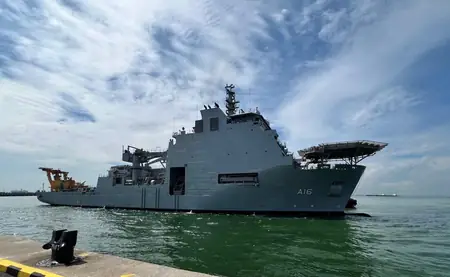
Visakhapatnam is set to host one of the Indian Navy’s grandest spectacles in 2026: the International Fleet Review (IFR) and Milgem exercises. While nations like Pakistan and China are notably absent from the invite list, the event’s location alone is poised to reopen old wounds for Islamabad. This coastal city in Andhra Pradesh holds a pivotal place in naval history, marking the spot where Pakistan’s submarine PNS Ghazi met its watery end during the 1971 Indo-Pak War.
Back in December 1971, PNS Ghazi had stealthily approached to target India’s aircraft carrier INS Vikrant. But the destroyer INS Rajput turned the tables, sending the Pakistani vessel to the ocean floor. The subsequent diving operations to locate the wreck were led by the then-INS Nistar. Fast forward 55 years, and a brand-new, indigenously built INS Nistar stands ready at the same site, participating in the upcoming IFR.
This modern Diving Support Vessel (DSV) represents India’s self-reliance in maritime defense. Commissioned on July 18, 2025, INS Nistar is the first of its kind in the Indian Navy’s fleet. For decades, the force lacked dedicated DSVs, a gap now bridged with two vessels: Nistar and the upcoming Nipun. Built by Hindustan Shipyard Limited under a 2018 contract, these ships were slightly delayed due to the COVID-19 pandemic but are now operational game-changers.
Measuring 120 meters in length and displacing around 10,000 tons, INS Nistar boasts cutting-edge diving equipment and a top speed of 18 knots. Approximately 80% indigenous, it supports Deep Submergence Rescue Vehicles (DSRVs) crucial for submarine emergencies. In scenarios where a sub gets trapped or damaged, Nistar deploys DSRVs to depths, rescuing trapped sailors—a capability shared by only a handful of nations worldwide.
The name ‘Nistar,’ derived from Sanskrit meaning ‘salvation’ or ‘liberation,’ couldn’t be more symbolic. Stationed symbolically over PNS Ghazi’s resting place alongside the new INS Vikrant, it underscores India’s naval evolution. As global navies converge for IFR 2026, this deployment serves as a poignant reminder of past victories and future readiness, blending history with high-tech prowess.