
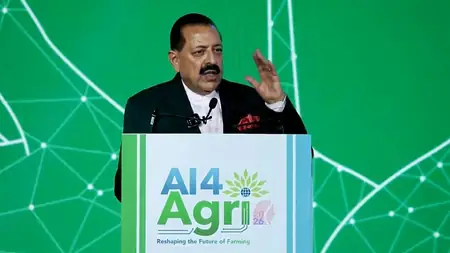
MUMBAI – India’s agriculture sector is on the cusp of a transformative revolution driven by artificial intelligence, Science and Technology Minister Dr. Jitendra Singh declared at the AI4 Agri 2026 summit here on Thursday. Addressing the opening session of the Global Conference on AI in Agriculture and Investor Summit 2026, he positioned AI as the cornerstone of future farming policies, research, and investments.
Dr. Singh highlighted how AI addresses longstanding structural challenges crippling farm productivity: erratic weather patterns, uneven access to information, and fragmented markets. ‘AI isn’t just another diagnostic tool; it’s a scalable treatment that can be rolled out nationwide,’ he emphasized, noting that a mere 10% productivity boost for 600 million farmers in the Global South could represent the century’s largest poverty alleviation opportunity.
Reframing agriculture from a traditional pursuit to a strategic powerhouse, the minister linked these efforts to the Rs 10,372 crore India AI Mission. This initiative is building indigenous supercomputing power, vast datasets, and startup ecosystems. He spotlighted BharatJan, the government-backed large language model ecosystem, which has launched ‘Agri Parm’ – a sector-specific AI model operating in 22 Indian languages. ‘This is AI that converses with farmers in Marathi, Bhojpuri, or Kannada,’ Dr. Singh said, underscoring linguistic inclusivity.
The Department of Science and Technology (DST) is backing the India AI Open Stack, an interoperable framework ensuring agri-AI solutions from any region integrate seamlessly into national systems. Research is accelerating through partnerships with IITs, IISc, ICAR, and the National Research Foundation, funding deep-tech AI applications in farming.
Innovations like drone and satellite mapping are already bolstering soil health cards and land ownership missions with verified data. Investments in climate intelligence integrate earth sciences and AI for early warning systems, empowering farmers to plan rather than panic. Biotechnology’s role in developing resilient, disease-resistant crops – detecting pests and plant diseases symptom-free early on – will drive a circular crop economy.
Dr. Singh painted a vivid economic picture: India’s 140 million farm units, mostly smallholders, could generate an additional Rs 70,000 crore annually if AI-driven advice saves each farmer just Rs 5,000 yearly through better investment timing, pest prediction, and market linkages. He praised Maharashtra’s Rs 500 crore MahAgri-AI Policy 2025-29 as a model, pledging central coordination for such state initiatives.
As India marches toward AI-led agritech dominance, these steps promise not just higher yields but equitable growth for millions of rural livelihoods.