
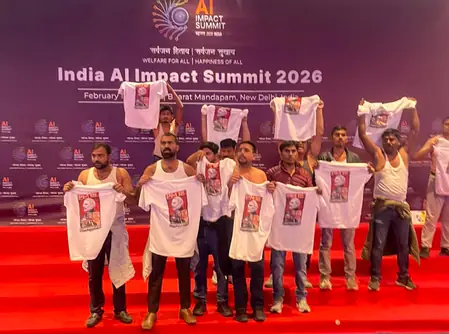
New Delhi erupted in tension during the prestigious AI Summit at Bharat Mandapam when Congress youth activists staged a disruptive protest, prompting swift action from Delhi Police. Four individuals have been arrested in connection with the incident that marred the high-profile event.
The protesters, identified as Congress workers, clashed with security personnel and attempted to create chaos amid the international gathering. Police sources revealed that the group had planned a more elaborate demonstration involving black umbrellas but abandoned it fearing detection. Instead, they printed provocative T-shirts, concealing them under jackets to sneak into the venue.
Among the detained is Narsimha Yadav, National Coordinator of Youth Congress, who is now under intense interrogation. Charges under multiple serious sections have been invoked, including those for assaulting police personnel. Videos circulating online show scuffles between the activists and officers, highlighting the unruly behavior.
Delhi Police is probing the origins of the printed T-shirts and treating the episode as a potential larger conspiracy. The force plans to present the accused in Patiala House Court soon, with preliminary findings pointing to premeditated disruption.
The Bharatiya Janata Party (BJP) has seized the opportunity to launch a scathing attack on Congress, accusing the opposition of anti-India antics. BJP spokesperson Shehzad Poonawalla quipped that for Congress, ‘AI’ stands for ‘Anti-India’, dubbing the party ‘Anti-National Congress’ (ANC).
MP Sambit Patra went further, alleging the shirtless protest was a meticulously planned scheme hatched at Rahul Gandhi’s residence, with active input from Priyanka Gandhi Vadra. Addressing a press conference at BJP headquarters, Patra condemned Congress for tarnishing India’s global image and held the party’s top brass accountable.
This clash underscores deepening political divides, especially as India positions itself as a leader in artificial intelligence. Authorities vow thorough investigation to prevent future disruptions at national events, while political rhetoric escalates ahead of key electoral battles.