
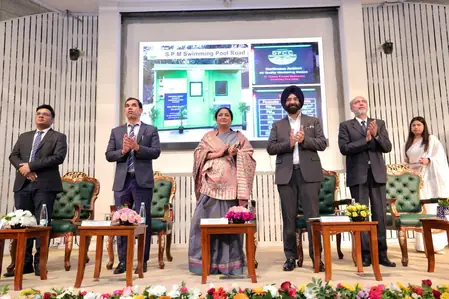
New Delhi’s battle against choking air pollution took a decisive turn today as Chief Minister Rekha Gupta inaugurated six advanced Continuous Ambient Air Quality Monitoring Systems (CAAQMS). In a bold move, she also flagged off the ‘Vayu Rakshak’ fleet, a team of 35 electric vehicles poised to patrol the city’s hotspots and enforce clean air measures on the ground.
Environment Minister Manjinder Singh Sirsa chaired the event, hailing it as a ‘strong step forward in the war against pollution.’ These state-of-the-art stations will track deadly PM2.5 and PM10 particles with pinpoint accuracy. The Vayu Rakshak fleet, backed by 100 dedicated personnel, will conduct live air quality checks across neighborhoods, ensuring swift action where pollution spikes.
With these additions, Delhi now boasts 46 monitoring stations, up from the previous count. This network promises real-time data from diverse areas, empowering authorities to pinpoint pollution sources—from industrial emissions to vehicular exhaust—and respond proactively.
The new stations are strategically placed at Jawaharlal Nehru University, Indira Gandhi National Open University, Netaji Subhas University of Technology’s West Campus, CWG Akshardham, CWG Delhi Cantt, and Talkatora Garden. Sirsa emphasized that unlike past regimes, the current government delivers solutions, not just complaints.
This initiative strengthens Delhi’s multi-pronged anti-pollution strategy, blending technology with grassroots enforcement. As winter smog looms, these measures could mark a turning point in reclaiming breathable air for millions. Experts predict improved data will guide policies like odd-even schemes and construction curbs more effectively.
Residents welcome the move, but stress the need for sustained efforts. ‘Real-time monitoring is great, but we need stricter penalties for violators,’ said a local activist. The government vows to expand this model, signaling a long-term commitment to cleaner skies.