
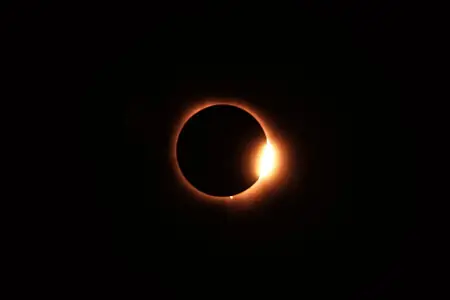
New Delhi, February 16 – The year’s inaugural solar eclipse of 2026 will grace the skies on Dars Amavasya, falling on a Tuesday. According to the panchang, this annular solar eclipse features the moon partially covering the sun, creating a stunning ‘ring of fire’ effect around the sun’s edges. Skywatchers in India, however, will miss the spectacle entirely as it won’t be visible from any part of the country.
Primarily observable in the southern hemisphere, the eclipse will captivate regions like Antarctica, South Africa, Zimbabwe, Zambia, Tanzania, Mauritius, and parts of South America. In Indian Standard Time, the event kicks off around 3:26 PM, peaks at approximately 5:42 PM, and concludes by 7:57 PM. Occurring in Aquarius sign under Dhanistha nakshatra, this celestial event holds astrological significance.
Religiously, solar eclipses trigger sutak 12 hours prior to commencement. Yet, since this eclipse remains invisible in India, no sutak period applies here. Experts from Drik Panchang confirm that sutak rules are waived in areas where the eclipse isn’t visible, allowing normal religious activities on February 17 without restrictions.
On February 17, Amavasya tithi persists until 5:30 PM, with Dhanistha nakshatra lasting till 9:16 PM, followed by Shatabhisha. The moon transits Capricorn. Sunrise is at 6:58 AM, sunset at 6:13 PM. Auspicious timings include Abhijit Muhurat from 12:13 PM to 12:58 PM, Vijay Muhurat from 2:28 PM to 3:13 PM, Godhuli Muhurat from 6:10 PM to 6:36 PM, and Amrit Kaal from 10:39 AM to 12:17 PM.
Avoid inauspicious periods: Rahukaal from 3:24 PM to 4:48 PM, Yamaganda from 9:47 AM to 11:11 AM, and Adal Yoga from 9:16 AM to 6:57 PM. This eclipse promises a breathtaking ring of fire primarily over Antarctica, with partial phases visible across southern oceans and continents. It skips India, Sri Lanka, Nepal, much of Asia, Europe, North America, and northern Africa entirely, focusing its drama on remote southern locales.