
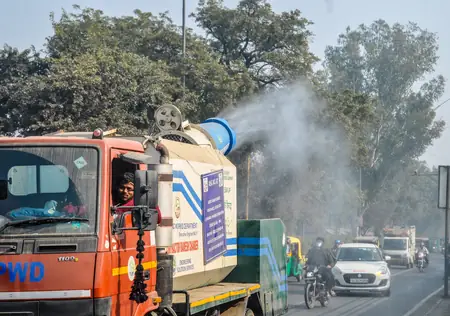
New Delhi witnessed a significant relief in its persistent air pollution woes on Wednesday as the Commission for Air Quality Management (CAQM) revoked Stage 2 restrictions under the Graded Response Action Plan (GRAP) across the National Capital Region (NCR). This decision came after consistent improvements in Delhi’s Air Quality Index (AQI), dropping to an average of 214, categorizing it as ‘Poor’ but showing a clear downward trend in pollutant levels.
The GRAP sub-committee meticulously reviewed the latest air quality data from the Central Pollution Control Board (CPCB) and meteorological forecasts before taking this step. Just days ago, on February 16, the AQI stood at a concerning 261, easing to 249 on February 17, and further to 214 by February 18. Favorable weather conditions, including better wind patterns, played a crucial role in this positive shift.
Forecasts from the India Meteorological Department (IMD) and the Indian Institute of Tropical Meteorology (IITM) predict the AQI will hover between ‘Poor’ and ‘Moderate’ in the coming days. In a official statement, the CAQM announced, ‘Observing the improving trend in Delhi’s average AQI, the sub-committee unanimously decided to immediately revoke Stage 2 GRAP measures across the entire NCR.’
However, this relaxation does not mean a complete rollback. Stage 1 GRAP measures remain firmly in place, with agencies directed to intensify enforcement to prevent any resurgence in pollution. The GRAP framework, which imposes tiered restrictions based on AQI levels, had activated Stage 2 on October 19 last year amid rising pollution trends.
Authorities emphasized continuous vigilance, urging all NCR implementing agencies to maintain strict monitoring. Citizens are advised to adhere to Stage 1 guidelines, such as dust control and waste burning bans, to sustain this progress. The sub-committee will continue daily reviews of real-time data, ready to reinstate stricter measures if needed.
This development offers hope to millions in the pollution-prone region, but experts warn that winter smog remains a seasonal threat. Coordinated efforts between government, industry, and public are essential to ensure cleaner air year-round.