
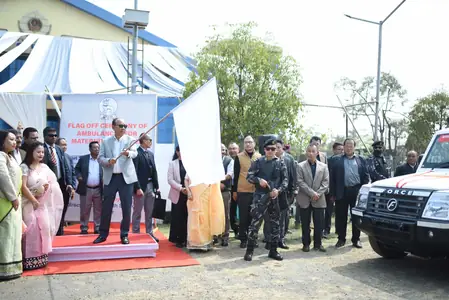
In a significant boost to maternal and child health services, Manipur Chief Minister N. Biren Singh on Saturday flagged off 33 dedicated maternity ambulances across the state’s 16 districts. The event, held at the Jawaharlal Nehru Institute of Medical Sciences (JNIMS) in Imphal East, underscores the government’s commitment to enhancing emergency healthcare in remote areas.
Funded by the North Eastern Council (NEC) and procured by the Directorate of Health Services, Manipur, these ambulances are equipped to provide critical care during pregnancy, delivery, and postnatal periods. Officials highlighted that the initiative aims to reduce maternal and infant mortality rates by ensuring timely medical interventions, particularly in hilly and underserved regions.
The Chief Minister also participated in the nationwide Human Papillomavirus (HPV) vaccination campaign targeting 14-year-old girls to prevent cervical cancer. Launched virtually by Prime Minister Narendra Modi from Ajmer, Rajasthan, the drive has gained momentum across states and union territories.
During his visit to JNIMS, Singh inspected registration counters, vaccination rooms, and observation areas. He interacted with medical staff and beneficiaries, personally handing over a vaccination certificate to one of the girls. He also reviewed the institute’s internal infrastructure, emphasizing the need for upgrades.
Prime Minister Modi, in his address, described the HPV campaign as a landmark in preventive healthcare. He stressed the government’s dedication to the health and empowerment of India’s daughters, noting that HPV infection causes nearly all cervical cancer cases.
The single-dose vaccine, administered to girls aged 14-15, protects against high-risk HPV strains. In Mizoram, Health Minister Lalrinpuii praised the central initiative amid rising cancer concerns. She pointed out that the state has the highest per capita cancer incidence in India, linked to tobacco use, poor diet, and unhealthy lifestyles including excessive consumption of smoked meat and pork fat.
Breast cancer remains the most common among women in India, followed by cervical cancer. With 99.7% of cervical cases tied to HPV, free vaccination is a game-changer. Other northeastern states actively joined the HPV drive, marking a regional push towards better women’s health outcomes.