
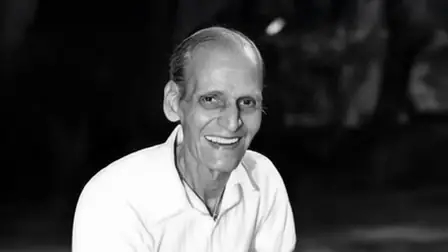
In the heart of Mumbai’s bustling film world, a poet emerged whose words could stir the soul of a nation. Kavi Pradeep, born Ramchandra Narayanji Dwivedi on February 6, 1915, in the quiet town of Badnagar, Madhya Pradesh, crafted verses that transcended generations. His immortal patriotic anthem ‘Ae Mere Watan Ke Logon’ remains etched in India’s collective memory, evoking tears from legends like Lata Mangeshkar and former Prime Minister Jawaharlal Nehru.
Pradeep’s journey began with a literature degree from Lucknow University. Drawn by dreams of literary glory, he arrived in Mumbai and adopted the name Kavi Pradeep to make his mark in cinema. Fate smiled early; in 1939, his performance at a poetry recital caught the eye of Bombay Talkies, offering him a 200-rupee monthly salary. This launched a prolific six-decade career where he penned nearly 1,700 songs for 71 films.
His pen was a weapon of patriotism. The 1940 film ‘Bandhan’s song ‘Chal Chal Re Naujawan’ was so incendiary that British authorities banned it. By 1943, songs from ‘Kismet’ forced him underground, as colonial rulers viewed his words as a grave threat to their regime.
The pinnacle came with ‘Ae Mere Watan Ke Logon,’ written in memory of soldiers lost in the 1962 India-China war. When Pradeep recited it to Lata Mangeshkar, she broke down in tears and agreed to sing it, insisting he attend rehearsals. She proposed a duet with Asha Bhosle, but Asha withdrew last minute, leaving Lata to perform solo.
On Republic Day, January 26, 1963, at Delhi’s National Stadium, before 50,000 spectators including Nehru and President Dr. S. Radhakrishnan, Lata’s rendition hushed the crowd. Nehru’s eyes welled up; he declared, ‘Anyone not moved by this song is no Indian.’
Honors followed, including the 1997 Dadasaheb Phalke Award, but personal tragedies struck hard. Widowed and paralyzed, abandoned by his four children, he found solace with a Kolkata businessman who cared for him till his death on December 11, 1998, at 83. Today, a postage stamp and the ‘Rashtriya Kavi Pradeep Samman’ keep his legacy alive.