
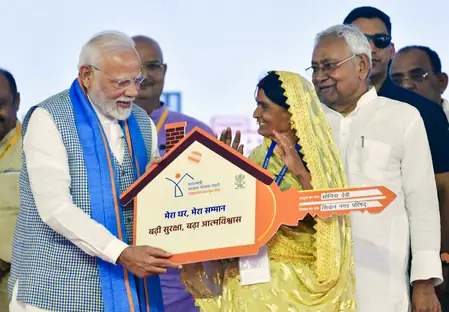
New Delhi’s ambitious Pradhan Mantri Awas Yojana (PMAY) has emerged as a beacon for developing nations, particularly those in the Global South. Launched to provide pucca homes to the urban and rural poor, PMAY transcends mere construction, embedding principles of social inclusion, gender justice, and economic empowerment at its core.
Recent analyses highlight how India’s ‘Housing for All’ initiative is redefining human rights in housing. Beyond bricks and mortar, it delivers dignity, security, and equality. A standout feature is prioritizing women as property owners—either solely or jointly—transforming them from dependents to empowered stakeholders.
In rural areas, PMAY-Gramin has constructed millions of durable homes, with nearly three-quarters registered in women’s names. Government directives mandate female inclusion in ownership, even retroactively for prior approvals. This shift bolsters women’s decision-making power within families, shields them from eviction, and unlocks opportunities like loans and entrepreneurship.
These homes integrate with broader welfare schemes—sanitation, clean water, electricity, LPG, and solar energy—creating holistic living environments that enhance health, privacy, and safety, especially for women.
Urban PMAY and its upgraded PMAY-Urban 2.0 target slum dwellers, low-income workers, and middle-class families with affordable housing. Strict rules ensure women head ownership for Economically Weaker Sections (EWS) and Low-Income Groups (LIG), signaling that subsidies reinforce property rights.
The Credit Linked Subsidy Scheme (CLSS) further amplifies impact, offering interest subsidies on home loans to underserved families, conditional on female ownership. This incentivizes banks and families to recognize women as credible borrowers and asset holders.
India’s model proves housing policy can drive gender equity and poverty alleviation, offering a scalable blueprint for the Global South where vulnerable populations grapple with insecure shelters.