
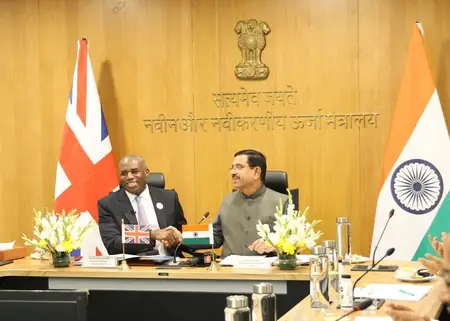
New Delhi witnessed a landmark moment in global clean energy collaboration as India’s Union Minister for New and Renewable Energy, Pralhad Joshi, and UK’s Deputy Prime Minister David Lammy unveiled the India-UK Offshore Wind Taskforce on Monday. Britain’s High Commissioner to India, Lindy Cameron, joined the virtual launch, underscoring the deepening ties between the two nations.
Minister Joshi emphasized that this initiative transcends symbolism, positioning itself as a robust working mechanism under Vision 2035 and the fourth Energy Dialogue. The taskforce aims to provide strategic leadership and coordination to propel India’s offshore wind sector forward.
The UK brings its world-leading expertise in scaling offshore wind and building resilient supply chains, while India offers a vast market, sustained demand, and a rapidly expanding clean energy ecosystem. Joshi dubbed it a ‘Trustforce,’ symbolizing mutual confidence to tackle real-world challenges head-on.
He outlined three key pillars of cooperation: first, ecosystem planning and market frameworks, including refined seabed leasing and stable revenue models; second, infrastructure and supply chains, focusing on port modernization, local manufacturing, and specialized vessels; and third, finance and risk management, attracting blended finance and long-term institutional capital.
India’s energy transition next phase prioritizes reliability, grid stability, industrial resilience, and energy security, with offshore wind playing a pivotal role. Potential sites off Gujarat and Tamil Nadu coasts have been identified, backed by studies from the National Institute of Wind Energy (NIWE). The government has allocated Rs 7,453 crore (about £710 million) in viability gap funding to kickstart projects.
Offshore wind’s complexities demand specialized ports, maritime logistics, robust leasing, and clear commercial frameworks. Joshi highlighted synergies with India’s Green Hydrogen Mission, where offshore wind can power coastal industries and hydrogen clusters. India leads the Hydrogen Breakthrough target under the International Breakthrough Agenda, achieving record-low prices: green hydrogen at Rs 279/kg and green ammonia at Rs 49.75/kg.
India’s non-fossil capacity now exceeds 272 GW, including over 141 GW solar and 55 GW wind. This fiscal year alone added over 35 GW solar and 4.61 GW wind. With clear targets and shared commitment, this partnership could anchor India’s clean, reliable, and self-reliant energy future, exemplifying India-UK collaboration under Vision 2035.