
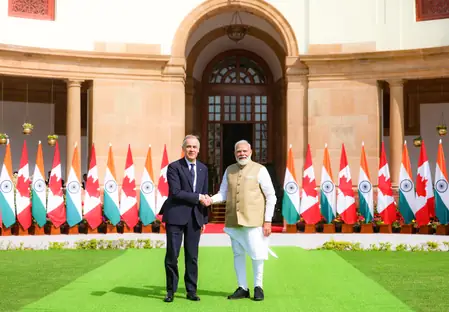
In a landmark move strengthening bilateral ties, India and Canada have inked a $2.6 billion uranium supply agreement, paving the way for advanced collaboration in nuclear energy. The deal, signed at Hyderabad House in New Delhi, was witnessed by Prime Minister Narendra Modi and his Canadian counterpart Mark Carney.
This pact ensures a steady long-term fuel supply for India’s civilian nuclear program, bolstering the nation’s clean energy ambitions. Both leaders hailed it as a cornerstone of economic partnership, emphasizing reliable and sustainable power sources.
Beyond the uranium deal, the two nations committed to joint development of small modular reactors (SMRs) and advanced nuclear technologies. This cooperation aims to harness cutting-edge innovations for global energy needs.
Discussions also accelerated negotiations on a Comprehensive Economic Partnership Agreement (CEPA), targeting finalization by late 2026. PM Modi outlined an ambitious goal to scale bilateral trade to $50 billion by 2030, fostering investments and job creation across both economies.
Additional pacts covered critical minerals, renewable energy, and cultural exchanges. Foreign Ministers S. Jaishankar and Anita Anand exchanged documents in the presence of the leaders.
PM Modi praised Carney for injecting new vitality into India-Canada relations, rooted in shared democratic values, respect for diversity, and commitment to humanity’s welfare. He stressed transforming these values into a deeper strategic partnership.
The talks expanded collaboration on renewables and climate action, with Modi welcoming Canada’s joining of the International Solar Alliance and Global Biofuels Alliance. In technology, focus areas included AI, quantum tech, supercomputing, and semiconductors, positioning both countries as natural partners in innovation.