
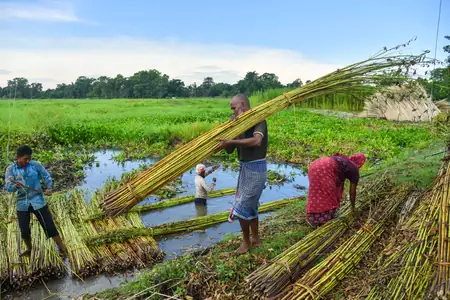
New Delhi: In a major relief for jute farmers, the Indian government on Tuesday announced a significant hike in the Minimum Support Price (MSP) for raw jute. The decision, approved by the Cabinet Committee on Economic Affairs chaired by Prime Minister Narendra Modi, sets the MSP at Rs 5,925 per quintal for the TD-3 grade during the 2026-27 marketing season.
This upward revision of Rs 275 per quintal from the previous year’s rate ensures a robust 61.8% return over the all-India weighted average production cost. It aligns perfectly with the government’s 2018-19 budget commitment to fix MSP at least 1.5 times the production costs.
Since 2014-15, when the MSP stood at Rs 2,400 per quintal, the price has more than doubled to Rs 5,925—a staggering 2.5-fold increase. This progressive policy has translated into tangible benefits for growers. Between 2014-15 and 2025-26, the government disbursed Rs 1,342 crore as MSP payments, a sharp rise from the Rs 441 crore paid during 2004-05 to 2013-14.
The Indian Jute Corporation (IJCL) will continue as the nodal agency for price support operations, with the central government fully compensating any losses incurred. As the world’s largest raw jute producer, India concentrates over 99% of its output in West Bengal, Bihar, Assam, Odisha, and Andhra Pradesh. West Bengal alone accounts for more than 80% of production, thanks to its fertile alluvial soil and favorable climate.
This MSP enhancement not only safeguards farmers’ incomes but also strengthens the jute sector’s sustainability amid global market fluctuations. With jute positioned as an eco-friendly alternative to plastics, the move could spur greater cultivation and industry growth, benefiting millions of rural livelihoods.