
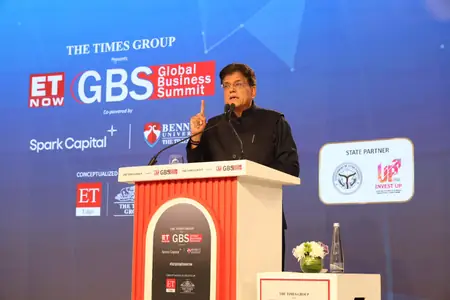
New Delhi witnessed a pivotal moment in India’s trade policy discourse as Commerce and Industry Minister Piyush Goyal declared that recent Free Trade Agreements (FTAs), particularly the interim pact with the United States, mark a profound structural transformation in how India engages with the global economy.
Speaking at the ET Now Global Business Summit (GBS) 2026 in the national capital on Friday, Goyal emphasized the safeguards embedded in the US deal to protect Indian farmers. ‘We were crystal clear during negotiations: our farmers’ interests must be shielded at all costs,’ he asserted.
The minister highlighted that sectors where India boasts self-reliance and high production—especially agriculture—were explicitly excluded from the agreement. ‘Over 95% of local agricultural produce remains protected,’ Goyal noted, underscoring a commitment to domestic priorities amid global integration.
Turning to the textile sector, Goyal addressed longstanding concerns about India’s lag behind competitors like Vietnam and Bangladesh. He revealed promising developments: ‘The European market is now open to our textiles duty-free, and the US has slashed reciprocal tariffs from 25% to 18%. This levels the playing field for us to compete globally.’
Goyal recalled assurances that Indian textile exporters would receive benefits parity with Bangladesh under its deals. This recalibration, he argued, positions India for a resurgence in apparel and fabric exports.
FTAs, according to Goyal, thrive on a foundation of trust, transparency, and time-bound certainty. Citing the India-EFTA agreement—with members Iceland, Liechtenstein, Norway, and Switzerland—as a blueprint, he illustrated New Delhi’s innovative approach to trade partnerships.
Under Prime Minister Narendra Modi’s ‘Reform Express,’ India has surged to the world’s fourth-largest economy, poised to claim the third spot in the coming years. Goyal’s vision paints a future where strategic FTAs propel India toward sustained economic dominance.