
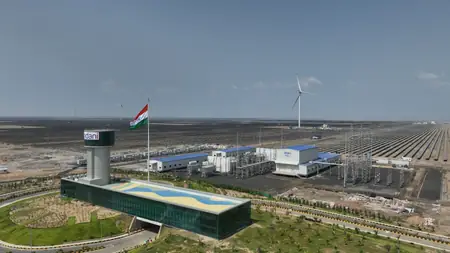
In a major boost to India’s renewable energy ambitions, Adani Energy Solutions Limited (AESL) has secured long-term funding from a consortium of Japanese banks for its ambitious high-voltage direct current (HVDC) transmission project. Announced on Monday from Ahmedabad, this initiative will create a 6,000 megawatt green energy corridor spanning nearly 950 kilometers from Bhadla in Rajasthan to Fatehpur in Uttar Pradesh.
The corridor is set to revolutionize power supply in northern India by efficiently transmitting clean energy from Rajasthan’s solar-rich regions to the national grid. This capacity is sufficient to power approximately 60 million households, addressing the surging demand for sustainable electricity in urban centers and industrial hubs alike. Slated for commissioning by 2029, the project underscores Adani Group’s commitment to bolstering India’s energy transition.
AESL CEO Kandarpa Patel highlighted the project’s significance, stating it represents a pivotal step in strengthening India’s green transmission infrastructure. He praised the support from Japanese banks and partners like Hitachi, reflecting the robust India-Japan partnership in clean energy pursuits. Patel emphasized AESL’s focus on building resilient, future-proof transmission networks to accelerate the shift to renewables.
Integral to Adani’s clean energy platform, the project draws from Rajasthan Adani Green Energy Limited’s (AGEL) vast solar production. The energy will flow to subsidiary Adani Electricity Mumbai Limited (AEML), which already sources over 40% of its supply from renewables, positioning Mumbai among global leaders in sustainable urban power usage.
Funding comes from prominent Japanese institutions like MUFG Bank Limited and Sumitomo Mitsui Banking Corporation (SMBC), signaling strong international confidence in India’s renewable projects. The initiative incorporates Hitachi’s cutting-edge HVDC technology, implemented in collaboration with BHEL, giving a fillip to domestic manufacturing capabilities.
This development is further evidenced by AESL’s recent BBB+ (Stable) credit rating from Japanese agency JCR, aligned with India’s sovereign rating, highlighting deepening financial and industrial ties between the two nations. As India races towards its net-zero goals, projects like this green corridor will play a crucial role in integrating vast renewable capacities into the grid seamlessly.