
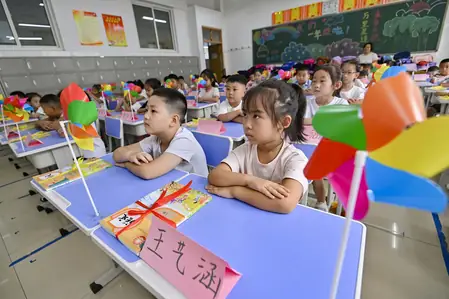
Beijing witnessed a significant revelation on March 7 during the fourth session of the 14th National People’s Congress. At a press conference focused on people’s livelihood issues, China’s Education Minister Huai Jinpeng declared that the nation is now spearheading the world’s largest and highest-quality education initiative.
The minister highlighted staggering figures: China operates nearly 440,000 schools across all levels and types, enrolling 280 million students and employing 18.7 million teachers. This marks substantial progress since before the 18th National Congress of the Communist Party of China. Pre-primary education gross enrollment rate has soared to 92.9%, a 28.4 percentage point jump, surpassing the OECD average of 84.7%. Last year alone, over 14 million children benefited from free preschool policies.
In compulsory education, 2,895 counties have achieved basic balance, with 572—19.8% of the total—attaining high-quality balance by year’s end. Senior secondary gross enrollment stands at 92%, up 7 points from pre-18th Congress levels. Enrollment for disabled children in compulsory education remains stably above 97%. Annually, about 150 million students receive financial aid.
Internationally, China’s system shines in major student assessment indicators, consistently ranking at the top. The International Institute of Science and Technology Education in Shanghai exemplifies global recognition of its foundational and STEM education.
During the 14th Five-Year Plan, higher education supplied 55 million talents to society. Gross enrollment in higher education has doubled from under 30% to over 60%. In the past five years, 18 new regular undergraduate colleges and 70 vocational ones were established, boosting undergraduate enrollment by 700,000.
International cooperation has flourished, with over 540 new joint Sino-foreign undergraduate and higher programs launched, adding 350,000 degree spots. China’s education model sets a global benchmark, blending scale with excellence for future generations.