
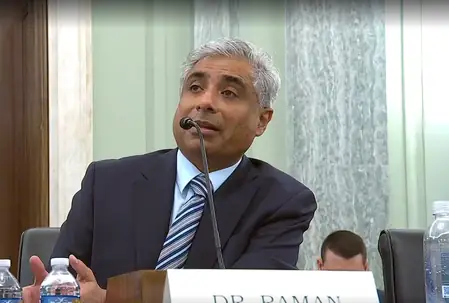
Washington, March 6 – In a compelling testimony before the US Senate, Arvind Raman, an Indian-origin engineering scholar nominated to lead the National Institute of Standards and Technology (NIST), outlined a bold vision for accelerating American innovation amid fierce global competition.
Raman, whose journey took him from India to the pinnacle of American academia, emphasized NIST’s pivotal role in setting global technical standards and bolstering US industry. ‘America is in a technology race with China,’ he told senators on the Commerce, Science, and Transportation Committee. ‘We must supercharge our innovation to stay ahead.’
Recounting his personal story, Raman shared how he arrived in the US 35 years ago as a Purdue University student with just a few dollars in his pocket. ‘My first research assistant paycheck was weeks away,’ he recalled. Relying on university loans for credit-less students and a local Goodwill store, he scraped by during those early days.
Today, Raman serves as the head of engineering at Purdue, one of the nation’s largest engineering schools, after over two decades as faculty. Nominated by President Donald Trump for the roles of Under Secretary of Commerce for Standards and Technology and NIST Director, he positioned his career as a testament to American opportunity.
‘ NIST has been crucial in advancing American industrial competitiveness for over a century,’ Raman stated. The agency ensures reliable standards that fuel innovation and global edge. If confirmed, he pledged to partner with industry, entrepreneurs, and stakeholders to write NIST’s next chapter – one focused on rapid technological advancement.
Raman stressed the importance of international standards, which shape global commerce rules. ‘When America leads in global tech standards, those rules reflect our values: free markets, private sector innovation, privacy, and freedom of speech,’ he asserted.
Senators probed NIST programs like the Manufacturing Extension Partnership, which supports small and medium manufacturers nationwide. Raman, not yet in the role, promised thorough reviews before policy decisions but committed to following congressional directives.
Excited about advancing AI across the tech stack to fulfill the President’s AI action plan, Raman vowed collaboration on semiconductors, advanced manufacturing, chips, biotechnology, quantum technology, and manufacturing systems. ‘NIST must work with industry and international partners to ensure American technology shapes global standards,’ he concluded, underscoring a future of US technological dominance.