
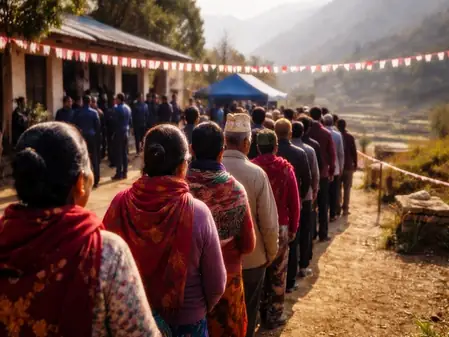
Kathmandu is buzzing with anticipation as Nepal gears up for pivotal parliamentary elections on Thursday, marking a crucial step back toward democracy following last year’s tumultuous Gen-Z revolt. Acting Chief Election Commissioner Ram Prasad Bhandari has urged over 18.9 million registered voters to cast their ballots fearlessly, emphasizing the importance of this democratic exercise.
The elections will determine the 275 members of the House of Representatives, Nepal’s lower house of the federal parliament. Of these, 165 seats will be filled through the First-Past-The-Post (FPTP) system, while the remaining 110 will use Proportional Representation (PR). This mixed system aims to ensure broad representation across the Himalayan nation’s diverse political landscape.
These polls come in the wake of the violent Gen-Z uprising in September 2022, which claimed at least 77 lives and inflicted damages exceeding 84 billion Nepali rupees on public and private property, according to government estimates. The unrest had plunged the country into uncertainty, but Prime Minister Sushila Karki’s interim government has steadfastly steered Nepal toward these elections.
Bhandari assured the nation that all preparations are in place for a smooth voting process, from 7 AM to 5 PM across the country. Polling stations are equipped with ballots, ballot boxes, and facilities tailored for women and persons with disabilities. Election staff have been deployed, and materials distributed nationwide.
“Elections form the bedrock of representative governance,” Bhandari stated in his appeal. “I call on every voter to approach their polling stations with confidence and exercise their sacred right.” He committed to conducting free, fair, impartial, and intimidation-free polls.
With 3,406 candidates in the FPTP race and 3,135 lists under PR, competition is fierce. Among the voters, 9.66 million men and 9.24 million women are eligible, setting the stage for a historic turnout that could redefine Nepal’s political future post-revolt.