
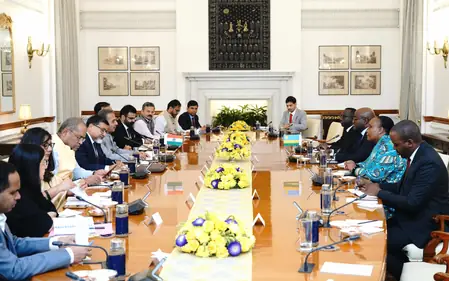
New Delhi witnessed a pivotal moment in India-Rwanda relations as the two nations held their second Joint Commission meeting on Tuesday. Co-chaired by India’s Minister of State for External Affairs Kirti Vardhan Singh and Rwanda’s Minister of Foreign Affairs and International Cooperation Olivier JP Nduhungirehe, the session delved deep into strengthening bilateral bonds.
Nduhungirehe arrived in India on Monday to participate in the 11th Raisina Dialogue alongside the commission talks. The discussions spanned a wide array of sectors including defense, agriculture, trade and investment, health, education, science and technology, digital platforms, culture, and people-to-people contacts. Senior officials, such as Economic Relations Secretary Sudhakar Dalela from India’s Foreign Ministry, were also present.
Singh shared his enthusiasm on social media platform X, highlighting the comprehensive review of ties and exchanges on regional and global issues. A key highlight was the signing of a Cultural Exchange Programme (CEP) for 2026-30, signaling deeper cultural collaboration ahead.
This meeting builds on robust historical ties. Rwanda’s envoy to India, Jacqueline Mukangira, noted earlier this year during the Vibrant Gujarat Regional Conference that Gujarat businesses are flocking to Rwanda, drawn by its investor-friendly environment featuring fiscal incentives, non-fiscal perks, and zero tolerance for corruption. India ranks as Rwanda’s second-largest foreign investor and trading partner, with key imports like pharmaceuticals, ICT machinery, rice, textiles, and sugar largely sourced from Gujarat.
Bilateral relations have flourished since Rwanda opened its mission in New Delhi in 1999 and appointed its first resident ambassador in 2001. India reciprocated by establishing a permanent mission in Kigali in 2018. These developments underscore a shared commitment to mutual growth, positioning both nations for enhanced cooperation in an interconnected world.