
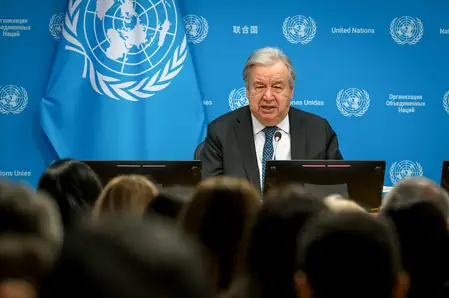
United Nations Secretary-General Antonio Guterres has launched urgent diplomatic efforts to defuse escalating tensions in the Gulf region, as fears of a broader war with Iran threaten to destabilize the global economy. Speaking through spokesperson Stephen Dujarric on Monday, the UN highlighted the severe risks posed by ongoing military activities, particularly their potential to disrupt worldwide energy markets.
The Gulf’s volatility has already sent oil prices soaring by 5.63% in a single day. Dujarric warned that any blockade in the Strait of Hormuz could trigger skyrocketing energy costs, hitting vulnerable economies hardest. ‘The impact always falls heaviest on the poorest nations,’ he emphasized, underscoring the humanitarian stakes.
Guterres expressed deep concern over the conflict’s potential spread to uninvolved countries like Jordan, Syria, Lebanon, and other Gulf states. In a series of high-level calls, he engaged Qatar’s Emir Sheikh Tamim bin Hamad Al Thani, Oman’s Foreign Minister Sayyid Badr bin Hamad Albusaidi, and ambassadors from the six-nation Gulf Cooperation Council.
Discussions with the Qatari leader focused on reverting to dialogue to restore stability amid rising military tensions. Guterres thanked Oman for mediating between Iran and the US, while reiterating condemnation of attacks on Iran and Iranian strikes on Gulf nations.
These strikes by the US and Israel came just two days after Geneva talks between Iran and Israel, brokered by Oman. The UN chief renewed his call for an immediate ceasefire, de-escalation, and resolution through sustained dialogue. As markets reel and regional powers brace for fallout, Guterres’ initiative represents a critical bid to avert catastrophe, reminding the world that diplomacy remains the only viable path forward in the face of mounting economic peril.