
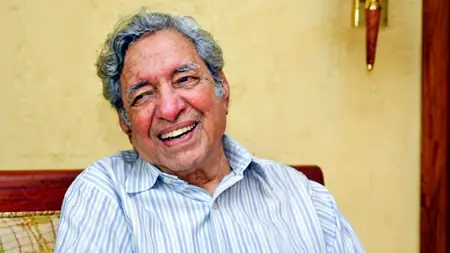
In the golden era of Hindi cinema, few music directors captured hearts like Ravi Shankar Sharma, fondly known as Ravi. Born on March 3, 1926, in Delhi, Ravi’s tryst with music began not in the halls of formal training but in the simple bhajans sung by his father. Those melodies seeped into his soul, teaching him the nuances of swaras without a guru’s guidance.
A born artist, Ravi mastered the harmonium as a child and soon handled multiple instruments with ease. Financial pressures forced him into odd jobs like electrician work, but his passion for music never wavered. In 1950, with dreams of becoming a playback singer, he arrived in Mumbai, the city of aspirations.
Reality hit hard. With no shelter, Ravi spent days chasing studio opportunities and nights sleeping on Malad station platforms. For two grueling years, he persisted. Breakthrough came in 1952 when he met Hemant Kumar and sang chorus in ‘Anand Math’s’ iconic ‘Vande Mataram.’ This marked the start of his illustrious career as a composer.
His debut as music director arrived with ‘Albelu’ in 1955, followed by a string of hits: ‘Vachan,’ ‘Narsi Bhagat,’ ‘Delhi Ka Thag,’ and the unforgettable ‘Chaudhvin Ka Chand.’ Ravi’s unique method—crafting lyrics first, then tunes—ensured every song was a timeless gem. ‘Chaudhvin Ka Chand’ earned him a Filmfare nomination in 1960.
The 1960s saw Ravi dominate with masterpieces in ‘Gharana,’ ‘Nazarana,’ ‘China Town,’ ‘Woh Kaun Thi,’ ‘Kajal,’ ‘Khanidan,’ and ‘Waqt.’ He scored over 50 films, blending melody with emotion. After a hiatus from 1970 to 1982, he roared back with B.R. Chopra’s ‘Nikaah.’ Later, as ‘Bombay Ravi,’ he enchanted Malayalam cinema from 1984 to 2005.
Awards for ‘Gharana’ and ‘Khanidan’ crowned his legacy. Ravi breathed life into Mahendra Kapoor’s hits. On March 7, 2012, the maestro bid farewell, leaving behind an indelible imprint on Indian music.